Northeastern Bulgaria keeps its oldest stories in stone. A horseman carved into a cliff face more than a thousand years ago, a scattered field of hollow columns standing in sand, and a monastery cut directly into a limestone wall — all within an hour’s drive of the Black Sea coast. In the latest episode of the Bulgaria From Above mini-series, Bronicable follows these three sites from the air.
Stone Wonders from a Bird’s-Eye View
What connects Madara, Pobiti Kamani and Aladzha Monastery is stone — worked by hand in two of them, shaped entirely by nature in the third. Seen from above, each reveals something the ground hides: the sheer scale of the Madara plateau, the true spread of the stone columns across the sand, and how deeply the monastery is set into its cliff.
Madara — The Rider in the Rock
The Madara Rider is carved into a vertical cliff roughly 23 metres above the ground, on the edge of the Madara plateau near Shumen. It shows a horseman driving a spear into a lion, with a dog running behind. The relief dates to the early eighth century and is surrounded by Greek inscriptions naming the Bulgarian rulers Tervel, Krum and Omurtag. It has been on the UNESCO World Heritage List since 1979 and remains the only rock relief of its kind in Europe.
From the air the setting makes sense in a way it does not from below. The cliff runs for kilometres, the plateau opens out above it, and the surrounding plain stretches to the horizon.
Pobiti Kamani — The Stone Forest
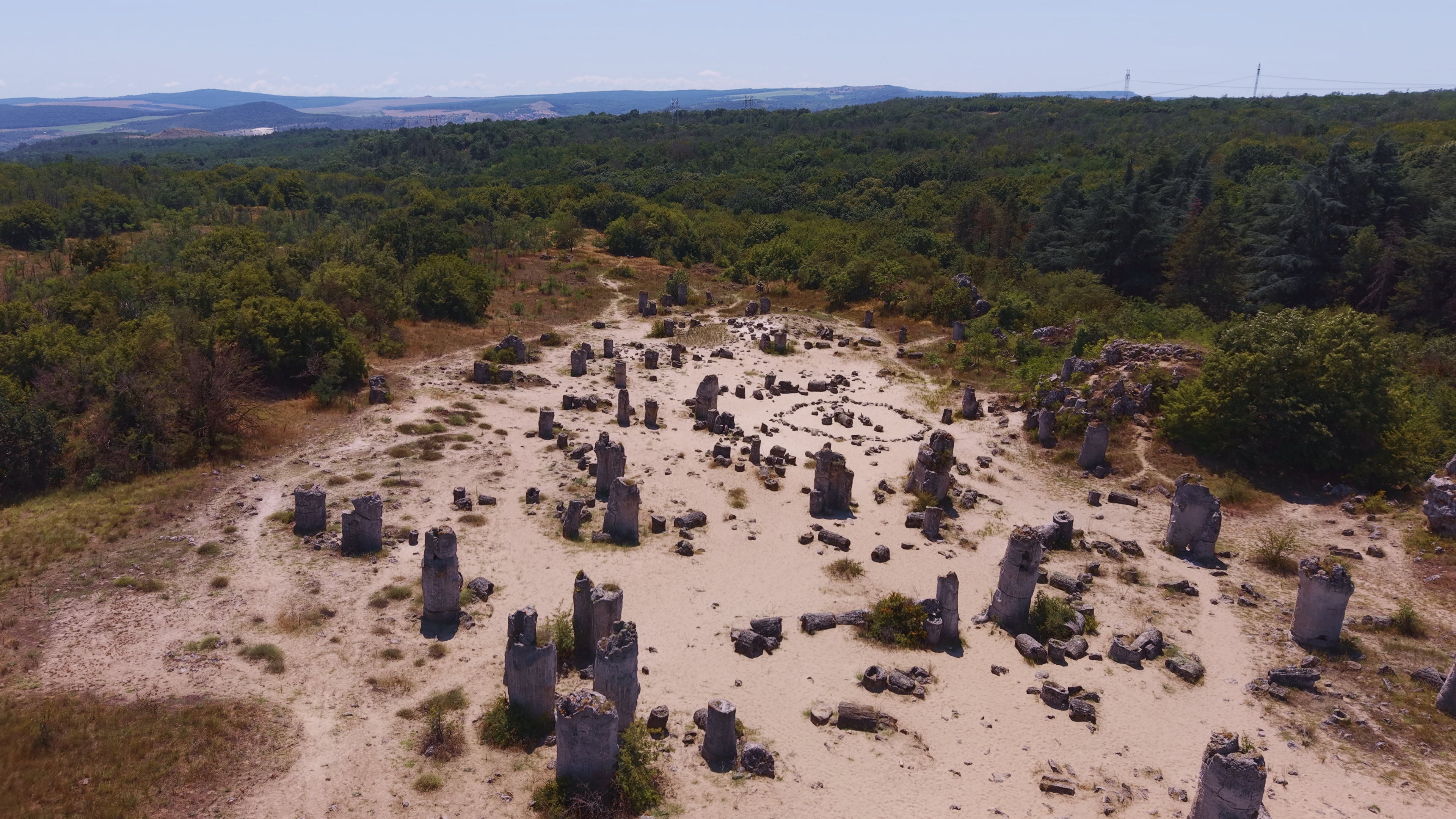
West of Varna lies Pobiti Kamani, known in English as the Stone Forest. Hundreds of hollow stone columns, some reaching seven metres, stand scattered across open sand — the closest thing Bulgaria has to a desert landscape. The formations are around fifty million years old, and their origin is still debated: some researchers point to ancient coral structures, others to mineral concretions formed in the seabed sediment.
Whatever produced them, from above the effect is striking — dark cylinders casting long shadows across pale ground, arranged in no order at all.
Aladzha Monastery — Carved into the Cliff
North of Varna, near the coast, Aladzha Monastery is cut directly into a forty-metre limestone wall. Its rooms, chapel and burial niches occupy two levels connected by rock-cut passages. The monastery was in use during the medieval period and is associated with hesychast monks who sought isolation in the cliffs. Its name comes from a Turkish word meaning variegated or many-coloured, most likely a reference to the frescoes that once covered its walls.
Seen from the air, the cliff face reads as a single unbroken wall of rock until the openings appear — small, dark and deliberate.
Ambient Music and 4K 60FPS Quality
Filmed in 4K 60FPS, this video delivers exceptional image quality with smooth, cinematic motion. Paired with a carefully mixed ambient soundtrack and no commentary, it creates a peaceful viewing experience, perfect for relaxation, background ambience, or simply discovering Bulgaria from above.
This video is perfect for:
- Relaxation and stress relief
- Focus, study and remote work background
- Calm ambient viewing and sleep
- A premium screensaver for 4K and OLED televisions
- Discovering Bulgaria’s archaeological sites from above
Watch the Full Video
👉 Watch the full aerial journey across Madara, Pobiti Kamani and Aladzha Monastery on YouTube:
For the best viewing experience, watch in full screen at the highest available quality.
Discover more aerial videos from Bulgaria on Bronicable and explore the complete Bulgaria From Above series.