Bulgaria is not short on history. It is layered into hilltops, courtyards, stone walls, museum halls and quiet mountain valleys. Sometimes it appears in the grandest places; sometimes it hides in a few surviving stones and asks you to imagine the rest. In this guide, I have gathered 10 historical sites in Bulgaria that make the country’s past feel close enough to touch.
I like historical places that leave room for curiosity. You do not need to know every date before you arrive. Walk slowly, look up, notice the details — and let the place tell you what it can. A practical note: the smaller sites keep shorter hours out of season, and a few of them close entirely in winter, so check before making a long drive.
Before the list, watch the video:
#10 — Bachkovo Monastery ▶ 0:44
📍 Rhodopes, south of Asenovgrad · 🏛 founded 1083 · 🎟 monastery free, museum and ossuary charged
Bachkovo is the second largest monastery in Bulgaria after Rila, founded by Grigorii Bakuriani, a Byzantine commander of Georgian origin — which is why its earliest history is Georgian rather than Bulgarian. The main courtyard, with its arcaded galleries and the 17th-century refectory, is the part most visitors see.
The building worth walking to is the ossuary, a short way from the monastery, which preserves frescoes from the 11th and 12th centuries and is the oldest surviving structure of the complex. Access to it is restricted, so ask on arrival rather than assuming. Bachkovo Monastery sits directly on the road towards Smolyan, which makes it an easy stop on any Rhodope trip — the courtyards, the €3.60 museum and the waterfall loop are covered in our separate guide.
#9 — Shumen Fortress ▶ 1:12
📍 on the plateau above Shumen · 🏛 Thracian, Roman, Byzantine and medieval Bulgarian layers · 🎟 ticketed, open-air site
The fortress is not one period but several stacked on the same rock. The first fortification here goes back to the first millennium BC, the walls were rebuilt in late antiquity, and its real peak came in the 12th to 14th centuries, when a substantial Bulgarian town stood inside them. It was burned by the Ottomans in the middle of the 15th century and never rebuilt.
What survives today is foundations, gates and a restored tower — the appeal is as much the position as the stones, with the whole Shumen plain below. The Monument to the Founders of the Bulgarian State stands on the same plateau and is a natural second stop.
#8 — Pleven Panorama ▶ 1:37
📍 Skobelev Park, Pleven · 🏛 opened 1977, depicting the siege of 1877 · 🎟 ticketed museum
The siege of Pleven was the longest and bloodiest episode of the Russo-Turkish War of 1877–78, and the town’s fall in December 1877 effectively decided the campaign that led to Bulgaria’s liberation. The Panorama was built on the battlefield itself for the centenary of those events.
Inside, a continuous circular canvas surrounds the viewing platform, with a modelled foreground running into the painting so that the join is invisible. The building stands in Skobelev Park, among the actual redoubts and memorials of the siege — walk the park afterwards rather than driving straight off.
#7 — Mezek Fortress ▶ 2:12
📍 Mezek village, near Svilengrad · 🏛 Byzantine, 11th century · 🎟 freely accessible
Mezek — locally called Neutzikon — is one of the best preserved Byzantine fortresses in the country, with much of its wall circuit and several towers still standing to a serious height. It guarded the approaches to the Maritsa valley and changed hands between Byzantium and Bulgaria more than once.
The other reason to come is a thousand years older. Just outside the village lies the Mezek Thracian tomb, a large beehive-vaulted burial from the 4th century BC, among the biggest of its kind in Bulgaria. Two sites, fifteen centuries apart, within a few minutes of each other.
#6 — Plovdiv Old Town ▶ 2:47
📍 Plovdiv, on the Three Hills · 🏛 Roman city, 19th-century Revival houses · 🎟 free to walk, individual houses ticketed
Plovdiv is one of the oldest continuously inhabited cities in Europe, and the Old Town is where the layers are visible at once. The Roman theatre — a theatre, not an amphitheatre — was built in the 1st century AD and only came to light after a landslide in the 1970s; it now hosts concerts and opera again. Part of the Roman stadium can be seen under the main shopping street.
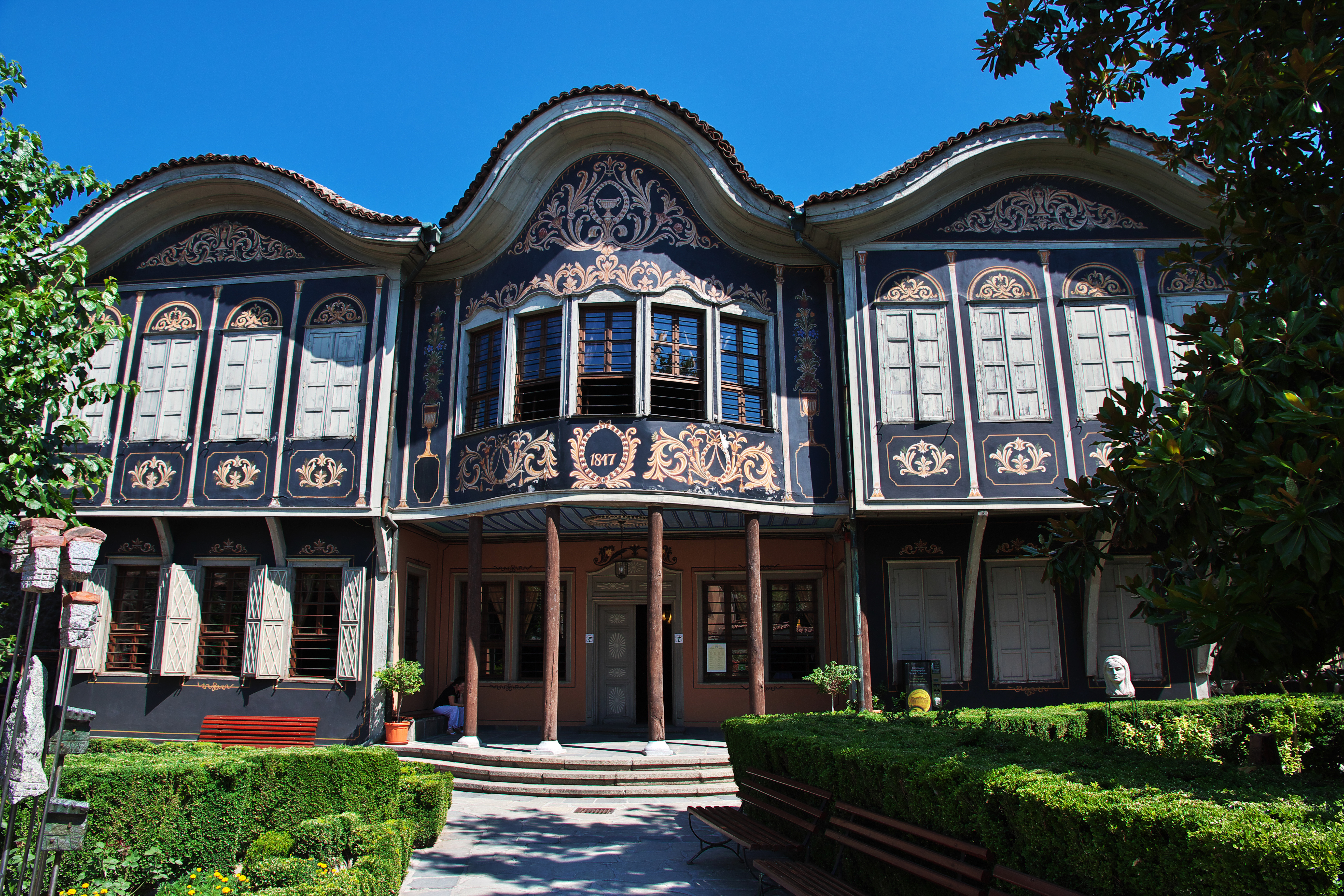
Above it stand the tall painted merchant houses of the 19th-century Bulgarian National Revival, several of which are open as museums. If you want to stay with Plovdiv for longer, continue with our guide to the best places to visit in Plovdiv. Wear something other than smooth soles: the cobbles are steep and genuinely slippery when wet.
#5 — Nicopolis ad Istrum ▶ 3:06
📍 near Nikyup, north of Veliko Tarnovo · 🏛 Roman, founded by Trajan around 106 AD · 🎟 ticketed, open-air site
Trajan founded the city to mark his victory over the Dacians, and it was laid out on a proper Roman grid with a forum, colonnaded streets and public buildings. Despite the name — “Nicopolis on the Danube” — the site is nowhere near the river; it stands on the Rositsa, and the name refers to the province rather than the location.
What you see today is street lines, column bases and the outline of the forum rather than standing buildings, so it rewards a slow walk and a little imagination. Most of the finds are displayed in the regional museum in Veliko Tarnovo, twenty kilometres to the south.
#4 — Devnya Mosaics Museum ▶ 3:26
📍 Devnya, west of Varna · 🏛 Roman villa, 3rd–4th century AD · 🎟 ticketed museum
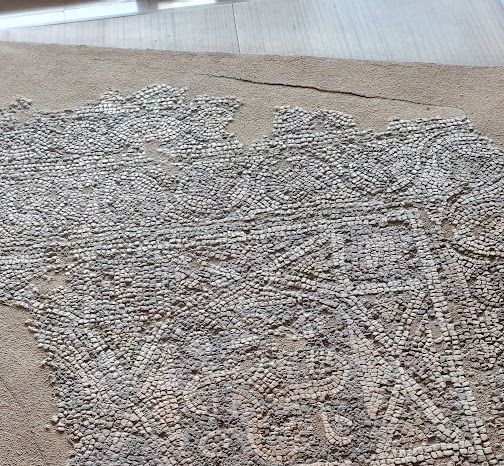
The museum is built directly over the remains of a late Roman townhouse, so the mosaics are seen where they were laid rather than mounted on a wall. That single decision is what makes the visit work — you walk around rooms, not exhibits.
The house stood in Marcianopolis, a city founded by Trajan and named after his sister, which was one of the largest urban centres in the Roman Balkans. The floors show mythological scenes and geometric panels, and the level of preservation is unusually high for this part of the empire.
#3 — Stara Zagora Neolithic Dwellings Museum ▶ 3:45
📍 Stara Zagora, in the hospital grounds · 🏛 Neolithic, 6th millennium BC · 🎟 ticketed museum
Two Neolithic houses were found here, burned down and buried in a way that preserved their walls, ovens and contents far better than usual. The museum was built over the excavation, so what you see is the original dwellings in place, with the pottery and tools left roughly where they fell.
They are among the best preserved Neolithic dwellings in Europe, and the appeal is domestic rather than monumental: a grain store, a grinding stone, the layout of a single room from eight thousand years ago. The location is unexpected — the museum stands inside the grounds of the regional hospital, so follow the signs rather than your instincts.
#2 — Starosel Thracian Temple Complex ▶ 4:06
📍 near Starosel, Sredna Gora, north of Hisarya · 🏛 Thracian, 5th–4th century BC · 🎟 ticketed, reduced hours in winter
The complex was excavated only at the turn of the 2000s and turned out to be the largest Thracian cult site found in Bulgaria. The main temple lies inside the Chetinyova mound, ringed by a monumental stone wall, with a staircase leading up to the entrance and a round chamber with half-columns inside.
Several more mounds and temples are scattered around the same valley, which was clearly a royal and religious centre rather than a single monument. It combines well with the Roman baths at Hisarya half an hour away if you want a full day of very different periods.
#1 — Tsarevets Fortress ▶ 4:24
📍 Veliko Tarnovo · 🏛 capital of the Second Bulgarian Empire, 12th–14th century · 🎟 ticketed, evening show on selected dates
Tsarevets was the heart of the Bulgarian state from 1185 until the Ottoman conquest in 1393: a fortified hill above a bend of the Yantra, holding the royal palace, the patriarchal cathedral and hundreds of houses and workshops. Baldwin’s Tower at the southern end is named after the Latin emperor held prisoner in Tarnovo.
The rebuilt Church of the Ascension at the summit is worth the climb for its interior: instead of traditional icons it was decorated in 1985 with stark modernist murals that still divide opinion. On set evenings a sound-and-light show lights the whole hill. For a wider look at Bulgaria’s fortresses, see our guide to Bulgaria’s castles and fortresses.