February 5 appears twice in Bulgaria’s history as a date when new political chapters formally opened — in 1879, the very beginning of the modern state; in 1947, the close of a wartime era.
February 5, 1879 — The First Bulgarian Post-Liberation Government Is Appointed
The first Bulgarian post-Liberation government was appointed under Prime Minister Todor Burmov after the restoration of Bulgarian statehood began to take institutional form. The new administration faced a task of immense difficulty: create ministries, laws, budgets, courts, schools, and local authorities in a country emerging from war and centuries of imperial rule. Even basic administrative routines had to be organized from scratch.
The early Bulgarian governments worked under international constraints and in a political environment still shaped by the Treaty of Berlin, Russian influence, and unresolved national questions. February 5 belongs to the foundational history of the modern Bulgarian state — the moment when freedom had to become paperwork, responsibility, and everyday administration.
February 5, 1947 — The Paris Peace Treaty with Bulgaria Is Signed
The Paris Peace Treaty with Bulgaria was signed after the Second World War, formally ending Bulgaria’s wartime status with the Allied powers. Bulgaria had joined the Axis camp but had not sent troops to the Eastern Front; in September 1944 it changed sides and fought against Nazi Germany. The peace settlement nevertheless imposed military limitations, reparations, and political consequences.
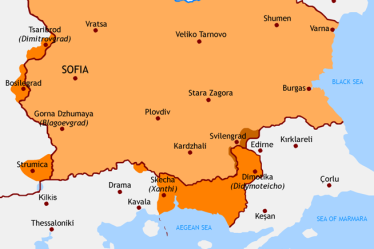
The treaty also confirmed Bulgaria’s borders, including the retention of Southern Dobrudzha, returned in 1940. For Bulgarians, February 5, 1947 marked the end of one diplomatic chapter and the beginning of another: the country was now firmly inside the Soviet sphere, and its transformation into a communist state was rapidly advancing.
Continue to February 6 or look back at February 4. Our Bulgaria From Above series offers a different perspective on the country.