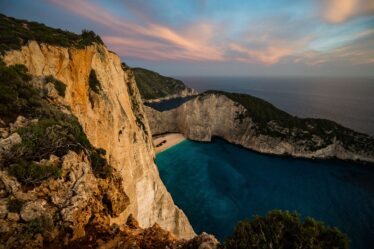
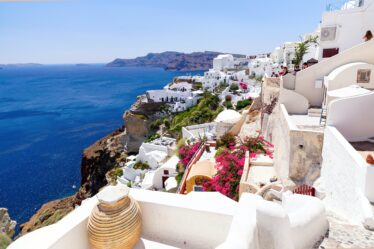
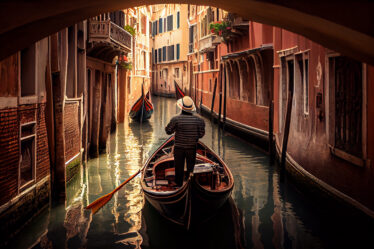
Europe’s beach towns offer more than sand and sunshine. They add history, food, nightlife and a sense of place to the seaside day. This list travels from Sorrento and Amalfi to Ibiza, Mykonos and Palma, with ten towns that each bring a different coastal mood. If you want a shorter Mediterranean route, our Greek beaches guide is a good place to continue.
Some are glamorous, some are lively, and some are best enjoyed slowly. The right choice depends on whether you want a party, a swim, a museum or simply a table with a view. One thing worth checking before you book: several of the most famous names on this list have very little actual sand, and the beach you have seen in photographs is often a drive away from the town centre.
Before the list, watch the video:
Full video on YouTube: Top 10 Beach Towns in Europe — the timecodes below jump straight to each town.
#10 — Sorrento, Italy ▶ 0:39
📍 Sorrentine peninsula, facing the Bay of Naples · ✈️ Naples, about an hour · 👥 classic, older crowd, excellent as a base
A point of geography first: Sorrento is not on the Amalfi Coast. It sits on the northern side of the same peninsula, looking across the bay at Vesuvius, while the Amalfi Coast proper is on the southern side over the ridge. The distinction matters when you are booking transfers.
Be realistic about the swimming, too — Sorrento sits on a cliff and its “beaches” are mostly wooden platforms built out over the rocks. What it does supremely well is act as a base: the Circumvesuviana train runs to Pompeii and Herculaneum, ferries go to Capri and Positano, and the town itself is full of lemon groves, cafés and a walkable old centre.
#9 — Rhodes Town, Greece ▶ 1:21
📍 Dodecanese, eastern Aegean · ✈️ Rhodes Diagoras, 20 minutes · 👥 history and beach in one place
The old town of Rhodes is the largest inhabited medieval town in Europe and a UNESCO site — a walled city of cobbled lanes, Ottoman-era mosques and the Street of the Knights running up to the Palace of the Grand Master. People still live and work inside the walls, which is what makes it feel like a town rather than a monument.
Elli beach is a few minutes’ walk from the walls, so a morning of history and an afternoon of swimming genuinely works here. Mandraki harbour, where the Colossus is traditionally said to have stood, is the connecting point between the two.
#8 — Amalfi, Italy ▶ 2:06
📍 Amalfi Coast, Salerno province · ✈️ Naples, then a slow coast road or a ferry · 👥 scenic, crowded in summer
Amalfi was a maritime republic long before it was a holiday destination, and the cathedral of Sant’Andrea, with its striped façade and the Cloister of Paradise, is the surviving evidence of that wealth. The town also has a paper museum, a reminder that Amalfi made paper by hand for centuries.
Villa Rufolo, often mentioned alongside Amalfi, is actually in Ravello, in the hills above — a short but steep trip, and worth it for the gardens and the concert terrace. Take the ferry rather than the coast road in high season; the road is beautiful and almost permanently jammed.
#7 — Albufeira, Portugal ▶ 2:54
📍 central Algarve · ✈️ Faro, 40 minutes · 👥 two towns in one — old quarter and nightlife strip
Albufeira splits cleanly into halves that suit very different holidays. The Old Town, above the beach, is whitewashed lanes, small restaurants and a tunnel down to the sand. The Strip, in Areias de São João, is bars and clubs and is not somewhere you want to book a quiet family week by mistake.
The famous sights are in opposite directions: Benagil sea cave is east, near Carvoeiro, reached by boat or kayak, and Ponta da Piedade with its rock arches is west, at Lagos. Both are day trips, not walks — plan them as such.
#6 — Nice, France ▶ 3:43
📍 Côte d’Azur · ✈️ Nice Côte d’Azur, next to the city · 👥 city break with a coast attached
Know before you go: the beaches in Nice are pebbles, not sand — smooth grey stones that are lovely to look at and hard on bare feet. Bring beach shoes and a mat and it stops being a problem.
Everything else is exceptional. The Promenade des Anglais runs for kilometres along the bay, Vieux Nice is a dense grid of ochre lanes with the Cours Saleya market at its heart, and the Matisse and Chagall museums are both here. The train line along the coast makes Monaco, Villefranche, Cannes and Menton all easy half-days.
#5 — Barcelona, Spain ▶ 4:24
📍 Catalonia · ✈️ El Prat, 30 minutes · 👥 everything at once, and busy with it
Barcelona’s beaches are a modern invention: the whole waterfront was industrial until the city rebuilt it for the 1992 Olympics, and Barceloneta and the beaches north of it were created then. That explains why they sit so neatly against the city grid.
The rest needs no introduction — the Sagrada Família, Park Güell, the Gothic Quarter, the Picasso Museum, Montjuïc. Book the Gaudí sites weeks ahead; turning up on the day rarely works. Tourism pressure is a live political issue in the city, so booking legitimate accommodation and spending outside the obvious streets is the decent way to visit.
#4 — Ibiza, Spain ▶ 5:02
📍 Balearic Islands · ✈️ Ibiza, 15 minutes from town · 👥 depends entirely on which half you choose
The clubbing season runs roughly from May to October and is concentrated in the south, around Ibiza Town and Sant Antoni. The north of the island is a completely different holiday: quiet coves, pine forest, farm restaurants and villages like Santa Gertrudis where nothing happens after ten.
Dalt Vila, the walled upper town of Ibiza Town, is a UNESCO site and worth the climb at sunset regardless of which Ibiza you came for. Formentera, half an hour away by ferry, has the clearest water in the Balearics and no nightlife to speak of.
#3 — Mykonos, Greece ▶ 5:46
📍 Cyclades · ✈️ Mykonos, or ferry from Athens · 👥 glamorous, expensive, loud in August
Mykonos delivers exactly what the photographs promise — white cubic houses, the windmills above Chora, the waterfront at Little Venice — and it charges accordingly. It is among the most expensive islands in Greece, and beach-club sunbeds at Paradise or Psarou can cost more than dinner.
The reason to come that nobody puts on a poster is Delos, half an hour away by boat: an entire uninhabited ancient island, birthplace of Apollo in myth and one of the most important archaeological sites in the Mediterranean. Also worth knowing: the meltemi wind blows hard in July and August and can flatten a beach day without warning.
#2 — Saint-Tropez, France ▶ 6:33
📍 Var, south of the Côte d’Azur · ✈️ Nice, roughly two hours by road · 👥 luxury, yachts, and a genuinely pretty old port
Two practical facts change how you plan this one. Pampelonne, the famous beach, is not in Saint-Tropez — it is a few kilometres away at Ramatuelle, and you need a car or a taxi. And the single road into the peninsula becomes a car park through August; the ferry from Sainte-Maxime is faster and far more pleasant.
Behind the yachts there is a real town: the pastel houses of La Ponche, the citadel above with its maritime museum, and the Musée de l’Annonciade, which holds an excellent collection of the post-impressionists who worked here before anyone had heard of the place.
#1 — Palma de Mallorca, Spain ▶ 7:00
📍 Mallorca, Balearic Islands · ✈️ Palma, 15 minutes · 👥 a proper city that happens to have beaches
Palma tops the list because it is not really a resort at all — it is a working Mediterranean capital with a cathedral, La Seu, that dominates the seafront and holds interventions by Gaudí and a chapel by the contemporary artist Miquel Barceló. Bellver Castle, circular and set in pine woods above the city, is unusual enough to be worth the walk up.
Playa de Palma, the long sandy beach, is about ten kilometres east at S’Arenal, so choose your base according to whether you want the old town or the sand. Beyond the city, the Serra de Tramuntana and the villages of Deià, Sóller and Valldemossa give Mallorca a depth that surprises people expecting only a beach island. For another coastal direction, our Greek islands guide is worth exploring.