Greek beaches have a talent for making a simple day feel cinematic. Clear water, bright stone, small tavernas and the kind of view that makes you stop talking for a moment — there is a reason people return. Here are five beaches in Greece that stand out for their scenery and atmosphere. If you are tempted by island-hopping, our guide to Greek islands is a natural next read.
Each beach has its own personality. Some are reached by boat, some reward an early start and others are simply impossible to forget once you have seen the landscape. Before you plan, note that none of the five are ordinary sand-and-sunbed beaches: two involve a boat, one is pebbles, one is protected and one has no shade at all.
Before the list, watch the video:
Full video on YouTube: Top 5 Beaches in Greece — the timecodes below jump straight to each beach.
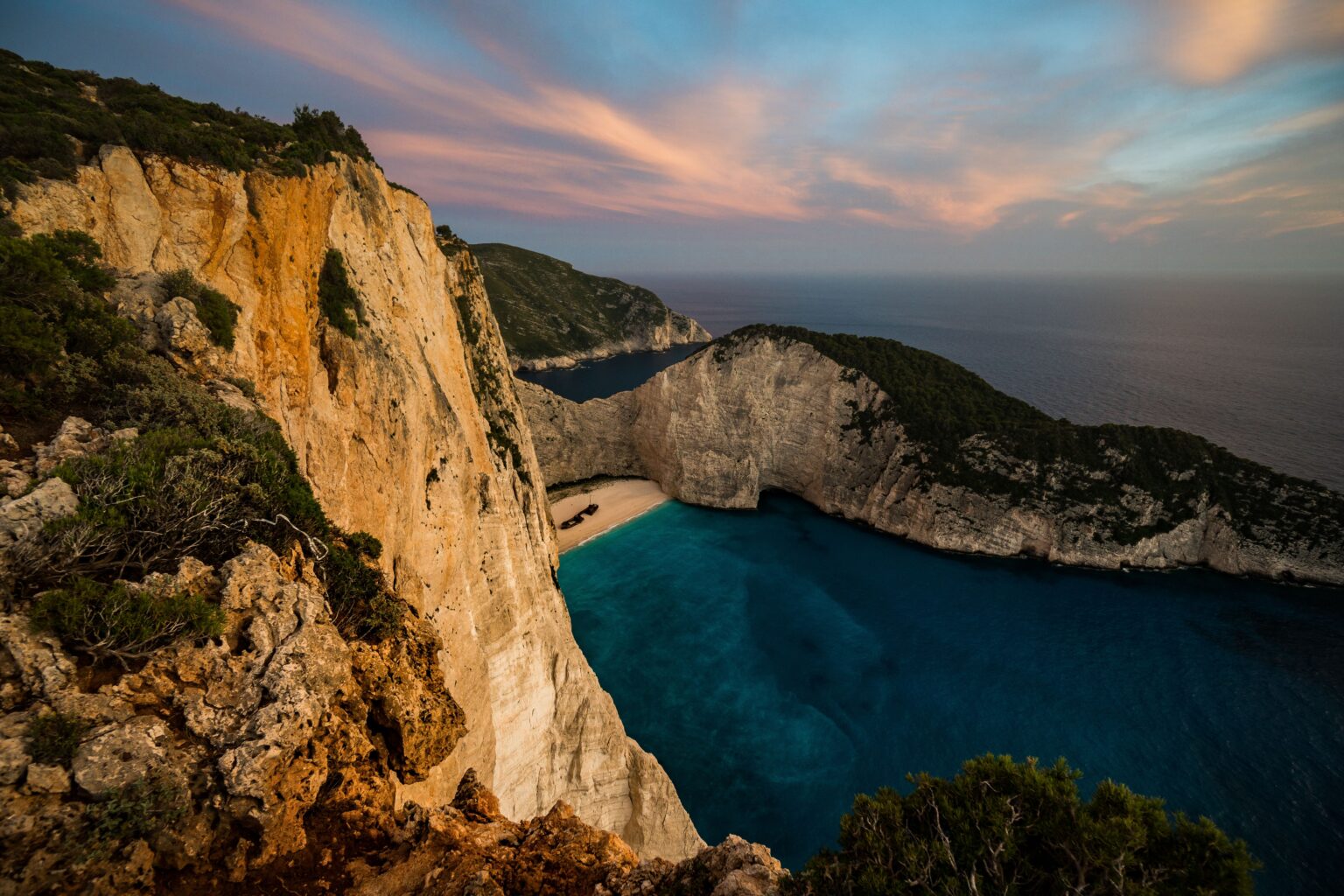
📍 northwest Zakynthos, Ionian Sea · 🚤 boat only, from Porto Vromi or Agios Nikolaos · 🏖 white pebble cove enclosed by cliffs
Navagio is the most photographed beach in Greece: a small cove walled in by sheer limestone, with the rusting hull of a freighter half-buried in the shingle. The ship ran aground in 1980 and has been there ever since, which is how the beach got its name — navagio means shipwreck.
An important practical point that most articles still leave out: the cliffs above are unstable, and after rockfalls injured visitors, access to both the beach and the clifftop viewing platform has been restricted at times. Check what is currently permitted before you book a boat, and treat any trip that promises unrestricted landing with scepticism.
#4 — Balos Beach, Crete ▶ 1:26
📍 Gramvousa peninsula, northwest Crete · 🚤 ferry from Kissamos, or dirt road plus a walk down · 🏖 shallow lagoon, pale sand with pink patches
Balos is a lagoon rather than a beach — a wide, shallow, almost bathwater-warm sheet of water cut off from the open sea by a sand spit, with the mountains of the Gramvousa peninsula rising behind it. Parts of the sand carry a pink tint from crushed shell.
Getting there is the decision. The ferry from Kissamos usually stops at Gramvousa island first, where a Venetian fortress sits above another wreck. The alternative is the unsealed road to the car park, which is rough enough that many rental agreements explicitly forbid it — followed by a twenty-minute walk down and a harder one back up.
#3 — Myrtos Beach, Kefalonia ▶ 2:49
📍 northwest Kefalonia, between Divarata and Assos · 🚤 steep road down, car park at the beach · 🏖 white pebbles, deep water close in
Myrtos is famous for its colour: the white stone of the shore turns the shallows an improbable pale turquoise that darkens to deep blue within a few metres. The viewpoint on the road above the bay is where most of the photographs are taken, and it is worth stopping there before descending.
Two things to be honest about. The shore is white pebbles, not sand — bring something to sit on. And the bottom shelves away steeply with a strong undertow when there is any swell, so this is not a beach for weak swimmers or small children on a windy day.
#2 — Elafonisi Beach, Crete ▶ 3:32
📍 southwest Crete, about two hours from Chania · 🚤 winding mountain road, large car park · 🏖 pink-tinged sand, shallow lagoon crossing
The pink comes from crushed shells of tiny marine organisms mixed into the sand, and it is strongest in patches rather than across the whole beach. A shallow lagoon separates the mainland from the islet of Elafonisi, and in calm conditions you can wade across in knee-deep water.
Elafonisi is a protected Natura 2000 area with rare dune plants and a nesting site for loggerhead turtles. Taking sand or shells away is prohibited and fined — the pink sand postcards you see for sale exist precisely because so many people tried. Go early; the road is slow and the car park fills by mid-morning.
#1 — Sarakiniko Beach, Milos ▶ 4:14
📍 north coast of Milos, Cyclades · 🚤 short drive from Adamas, ferry to Milos from Piraeus · 🏖 white volcanic rock, almost no sand
Sarakiniko does not look like Greece, or particularly like Earth. Milos is a volcanic island, and wind and sea have sculpted its soft white tuff into smooth ridges, hollows and channels that run down into a narrow inlet of dark blue water. People come as much to walk across the rock as to swim.
Manage expectations: there is no sand, no shade and no facilities, and the white surface reflects heat brutally by midday. Come early or late, bring water and shoes with grip — the rock is slippery where it is wet. The reward, especially at sunrise, is a landscape you will not confuse with anywhere else.
Greece has far more beaches than any single list can hold. Once you have finished here, our guide to Italian cities offers another Mediterranean direction for your next trip. And if you would rather have the mainland than the islands, Paralia, Meteora and Katerini make a three-day drive out of Pieria and Thessaly.