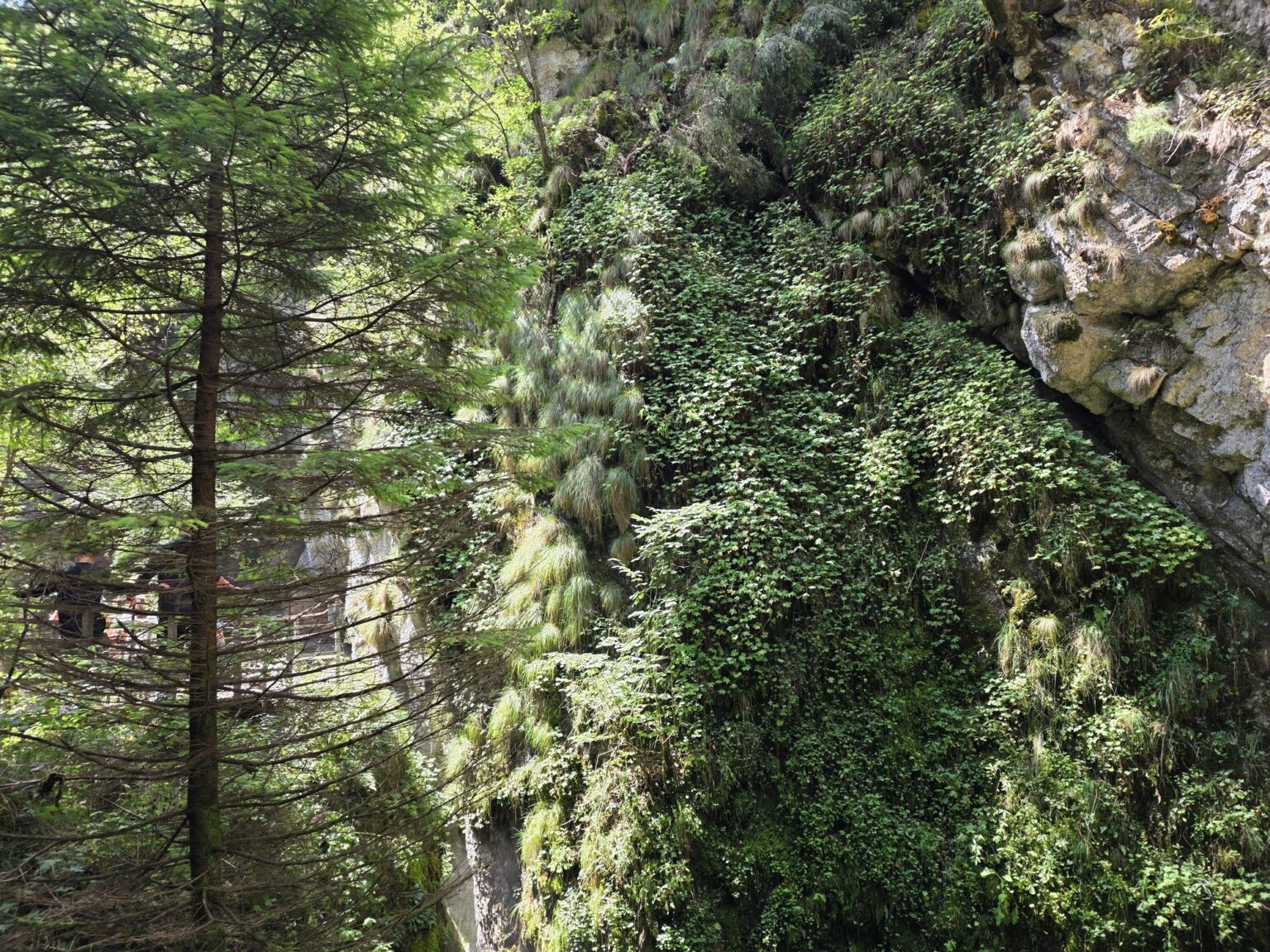
There are trips you set out on thinking “we’ll go in, have a look and head back”, and then you end up at the railing with no wish to leave. Devil’s Throat is one of those. The tour itself takes about half an hour, but with waiting for your group and staring down into the gorge afterwards it easily turns into an hour and a bit. There is exactly one road in — through the Trigrad Gorge, a canyon in the Western Rhodopes where the cliffs leave you a strip of sky. From the road you see nothing of the cave. Just a car park and people looking up.
A word on the setting, because it matters here: this is the far south-west of Bulgaria, six kilometres from the Greek border, in a valley that was a closed military zone until the end of the communist period. That is part of why the villages up here still feel like the end of the road 🙂
| Where it is | Western Rhodope mountains, southern Bulgaria, inside the Trigrad Gorge about 2 km from Trigrad village and 24.5 km from the town of Devin; Google Maps |
| Getting there | by car from Devin via Teshel and Gyovren towards Trigrad — the road passes the entrance itself. There is no public transport to the cave, so plan on a car or a tour; the last stretch is narrow and not suited to large coaches |
| Time needed | about half an hour for the tour; an hour and a bit in total, with waiting for your group and looking at the gorge afterwards |
| Opening hours | May – September 10:00 – 17:00; October – April 10:00 – 16:00. Groups go in on the hour, with a guide only. Open year round, no closing day. |
| Admission | adults €6.65, students and pensioners €5.62, children aged 8–16 €3.07 — from the last published price list, converted at the fixed rate. The guided talk is included. Check current prices with the Bulgarian Tourist Union, which manages the cave. |
| The route inside | a 150 m man-made tunnel on the way in, 350 m of walkway out of roughly 1 km of cave, and 301 steps back up to the natural entrance. Site no. 88 on the “100 National Tourist Sites” list, a Bulgarian collector-stamp scheme; the stamp is at the ticket desk |
| Nearby | the Trigrad Gorge itself (a separate site on the same list), Haramiyska Cave, Trigrad waterfall, and Yagodinska Cave about 16 km away |
| When to go | spring and after heavy rain, when the river is high and the waterfall is loudest; on a summer weekend come for the first hours of the day |
| Parking | free lay-by opposite the entrance, on the other side of the road; it is small and fills up even on a weekday morning |
Why it is called Devil’s Throat
Before we go in, a bit of background for the mood. The cave has not always had this name. Its old name was Klokotnik — roughly “the gurgler”, after the roar of the water you can hear from outside. Honestly, that name suits it better. But the other one stuck, and there are three explanations for it.
The first is about shape: the natural opening where the river throws itself down looks like an open devil’s head. The place further along where the water returns to the surface has been named by locals with equal logic — “the devil’s backside”. No comment 😀
The second is less charming: whatever goes into the throat does not come out the other end. There is a whole section on that below. The third is simply grim and only turns up in local tellings — that children lost their lives in the hole. The Thracians, who were here long before there was a sign and a ticket desk, treated the cave as a door to the afterlife and, the story goes, threw the bodies of their chieftains into it to make them immortal. From the same era comes the better-known tale:
Orpheus went down through here into the kingdom of Hades to bring back Eurydice. Hades agreed to let her go on one condition — that he not look back until they reached the light. Orpheus looked back.
The Rhodopes claim Orpheus as a local anyway, so the version told here goes largely unchallenged 🙂
The car park opposite the entrance
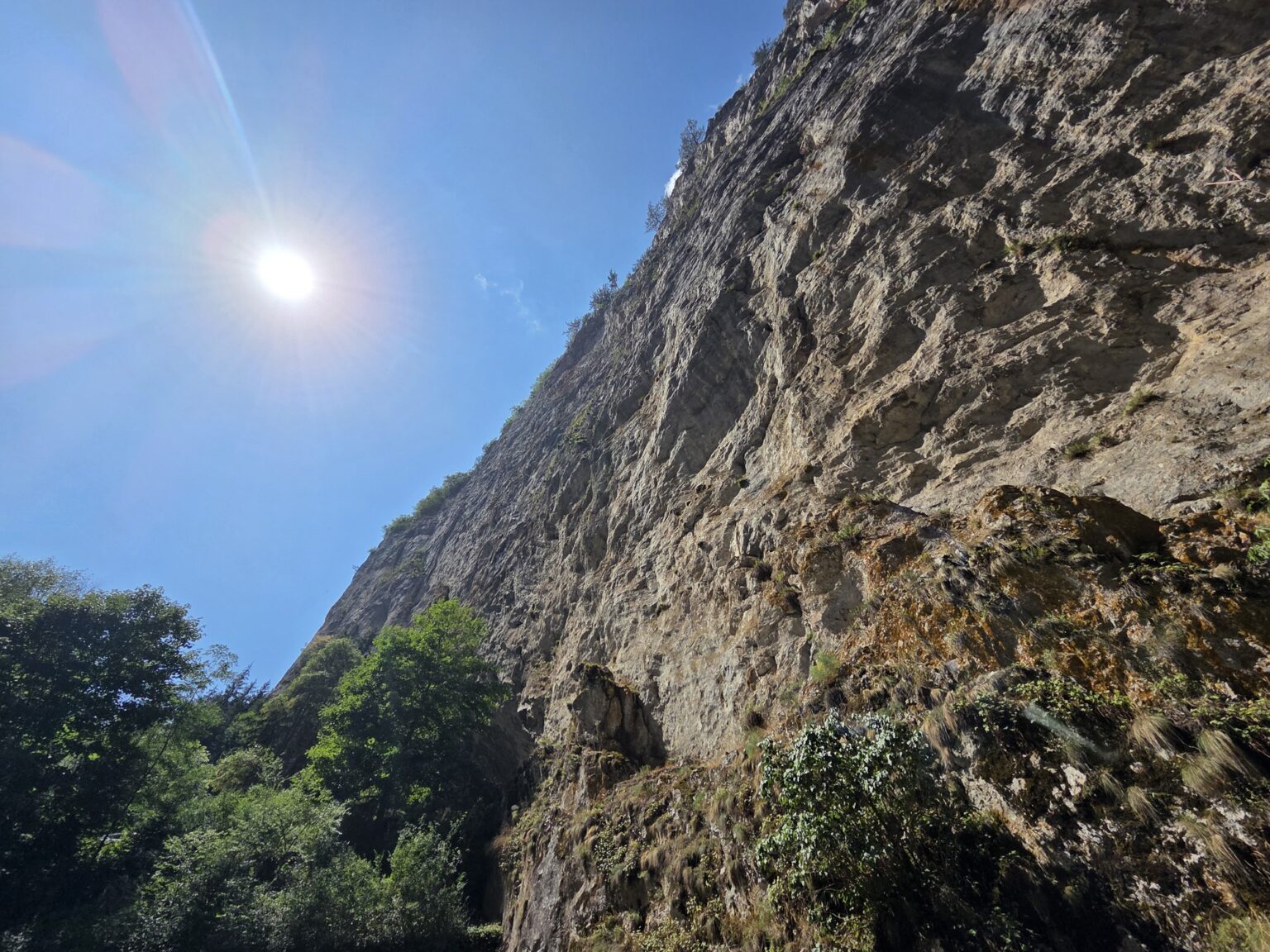
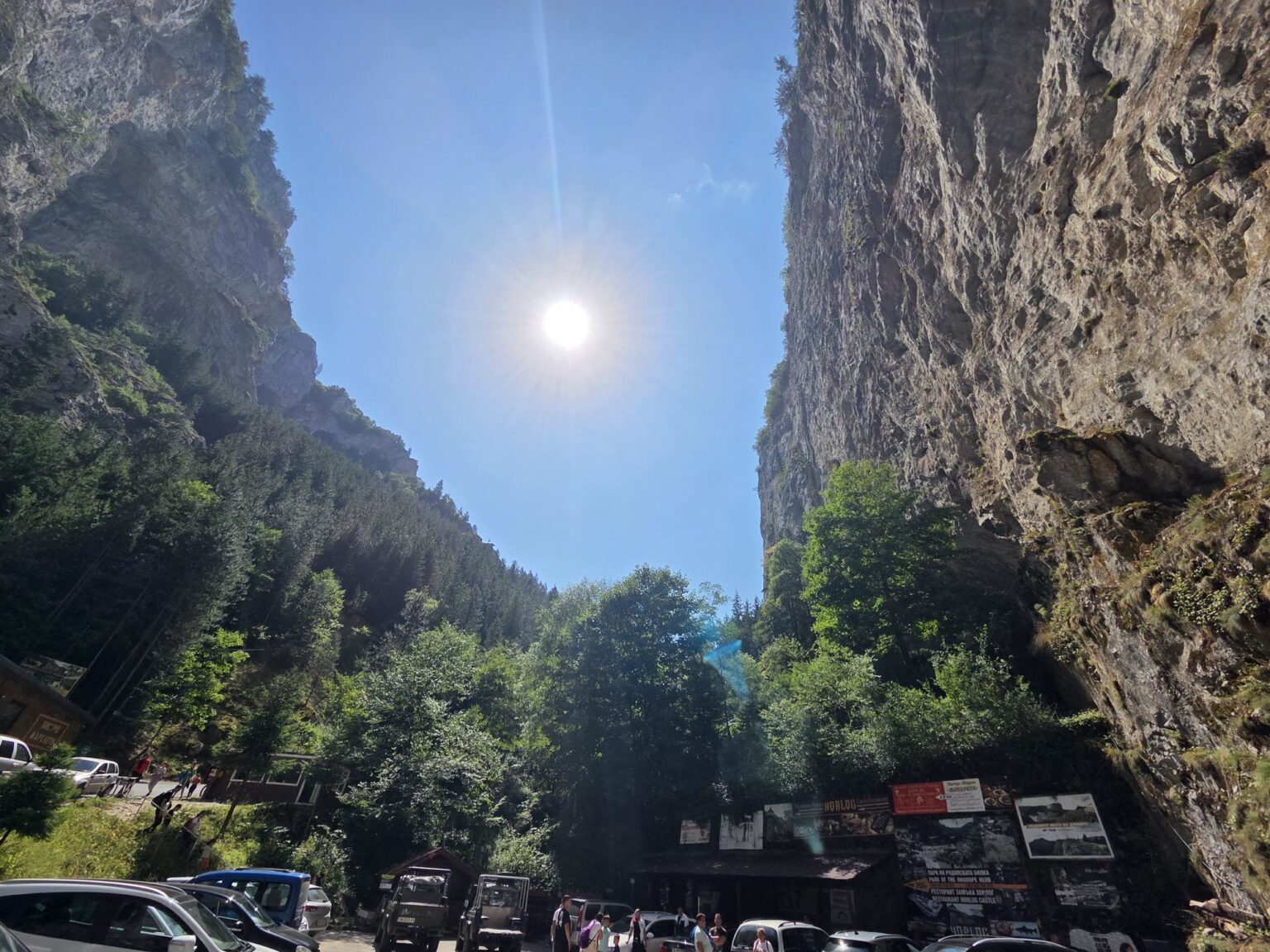
The parking area sits directly across the road from the cave and is exactly as wide as the rock allowed. A dozen cars angled along it, and people at the edge looking up — because there is nowhere else to look. The wall rises sheer and the sun only reaches its top edge.
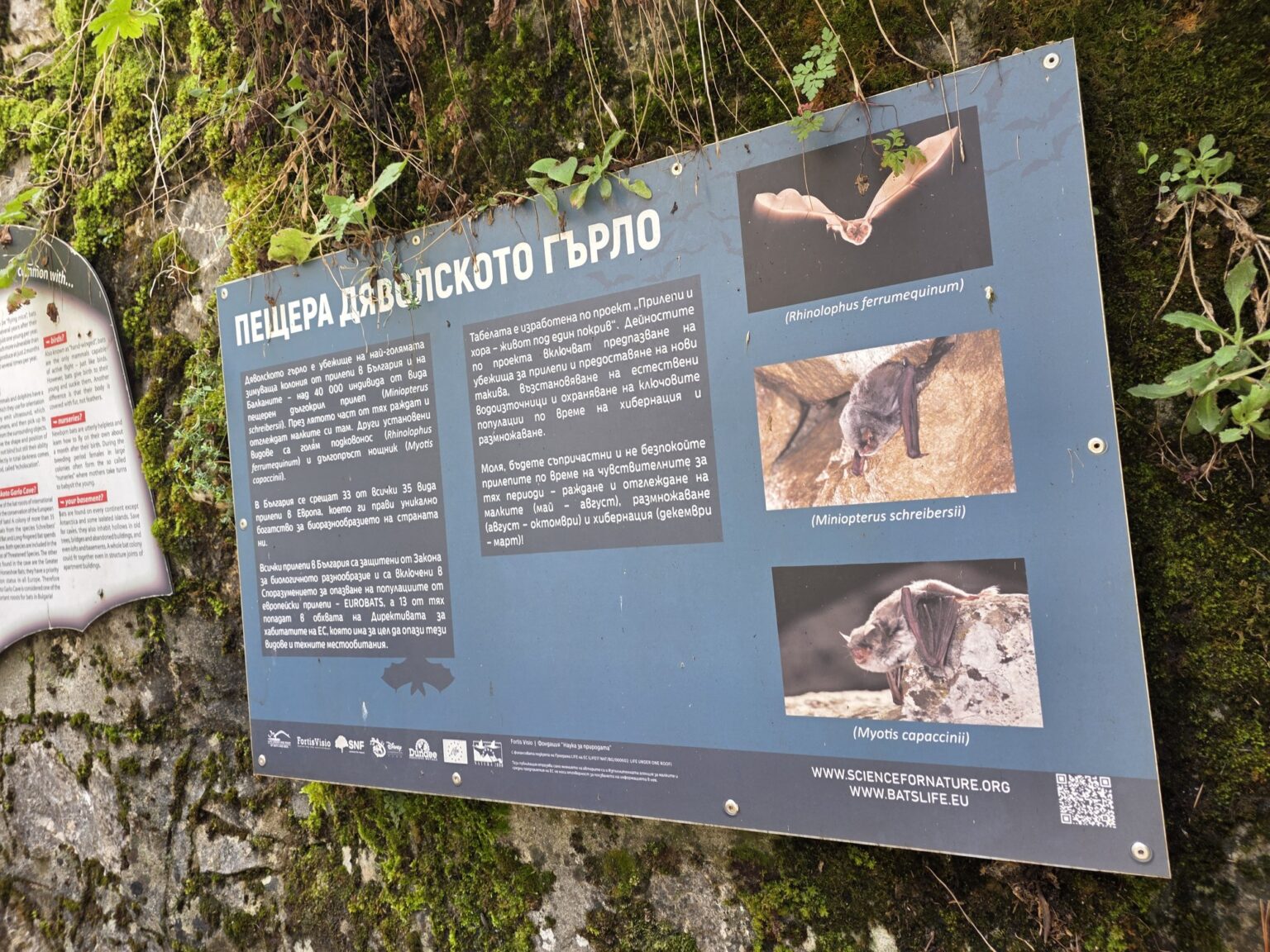
The information board is bolted straight onto the rock face rather than a post. There is nowhere to sink a post. The ticket desk releases groups on the hour, guide only, so if you have missed one hour you wait for the next and read the board three times. We read it three times.
A 150-metre tunnel and the Roaring Hall
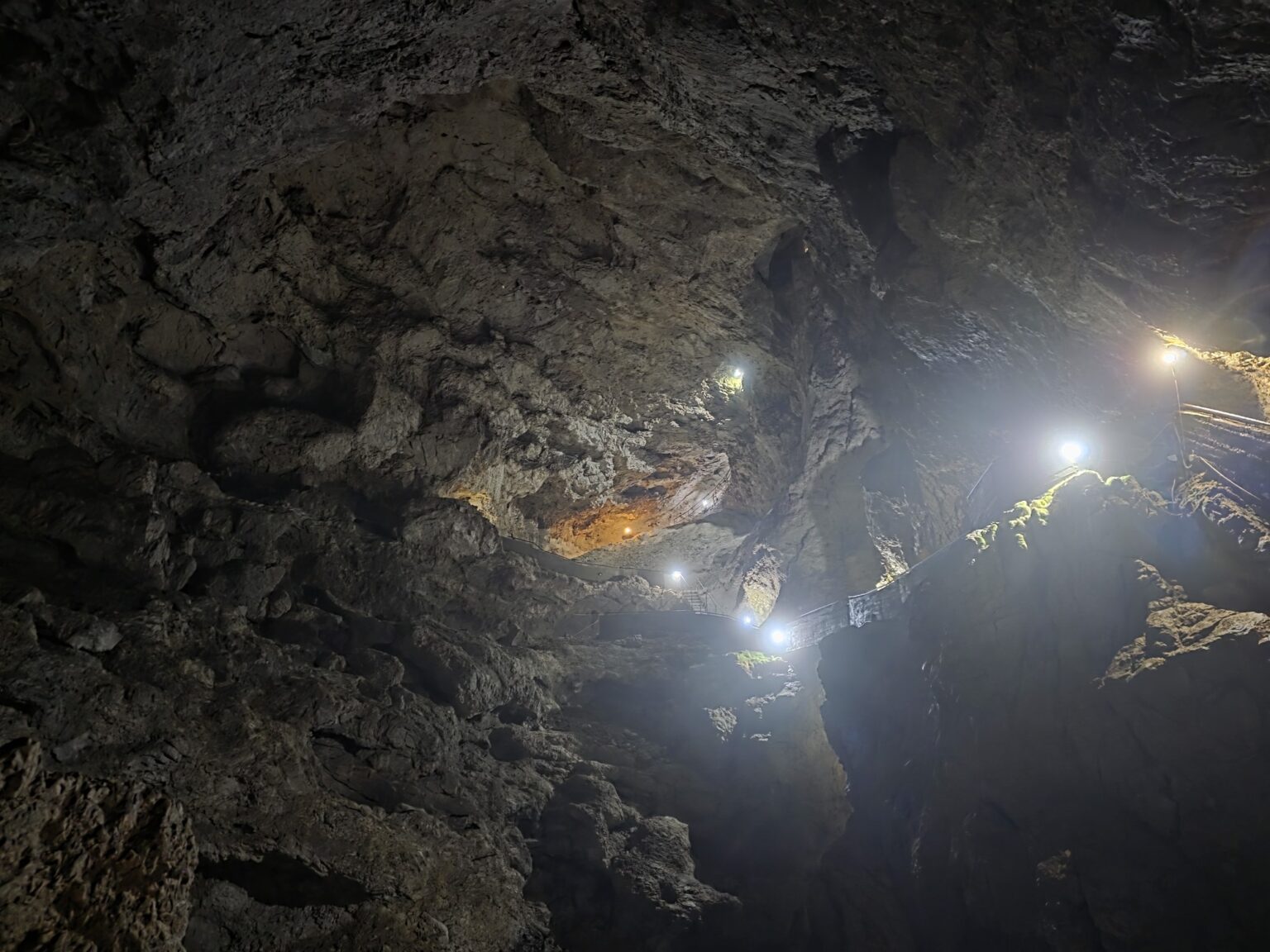
The entrance is not an entrance but a tunnel cut 150 metres into the rock. Narrow corridor, wet walls, lamps at floor level. There are no stalactites, and that is not an accident: the cave is 175,000 years old, which in geological terms makes it a baby, and there are nearly 200 metres of marble above the gallery — a single drop needs more than a hundred thousand years to work its way down. What there is instead is sound. At first like a motorway in the distance, then like a washing machine, then like something you would rather was further away.
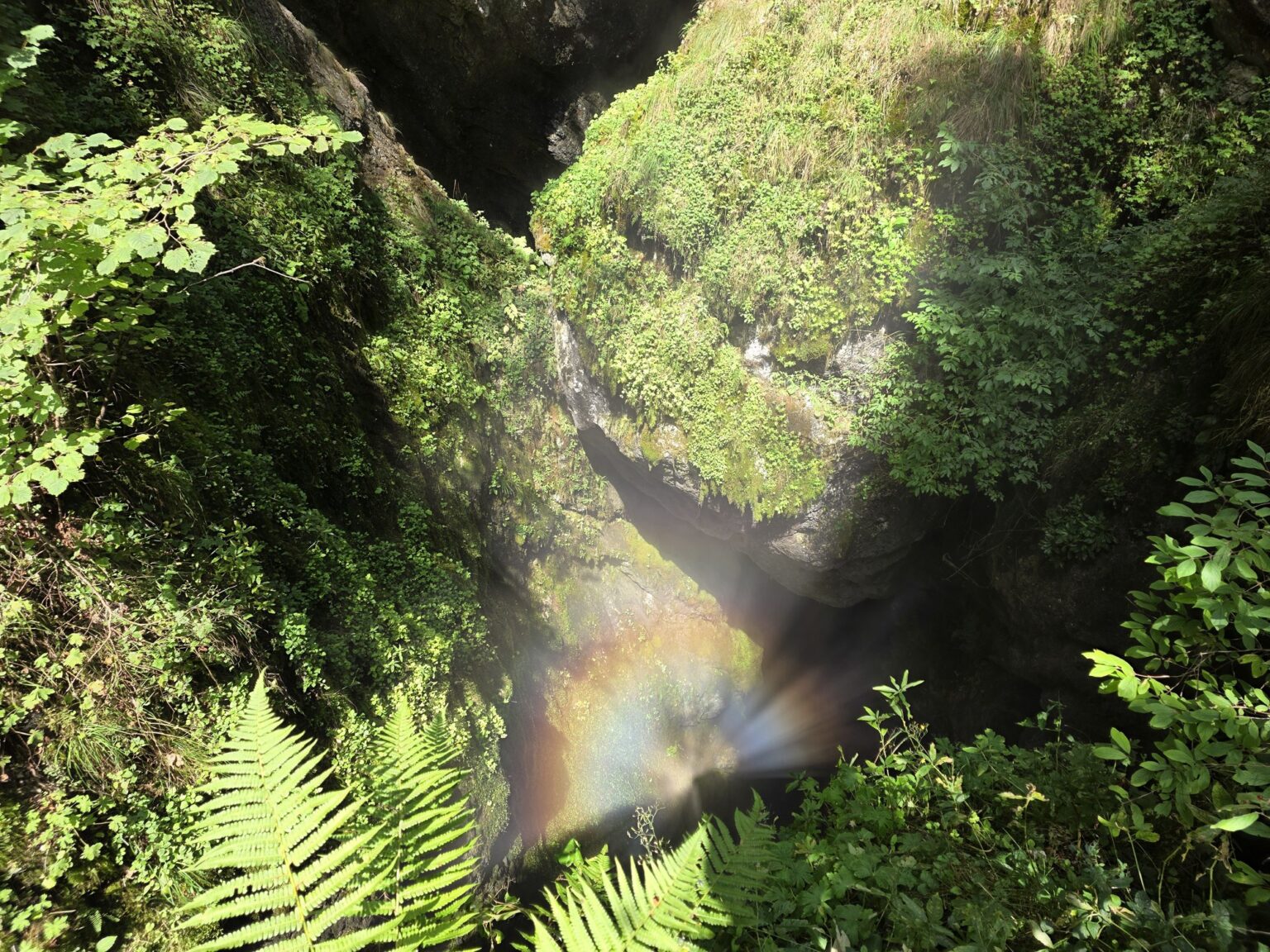
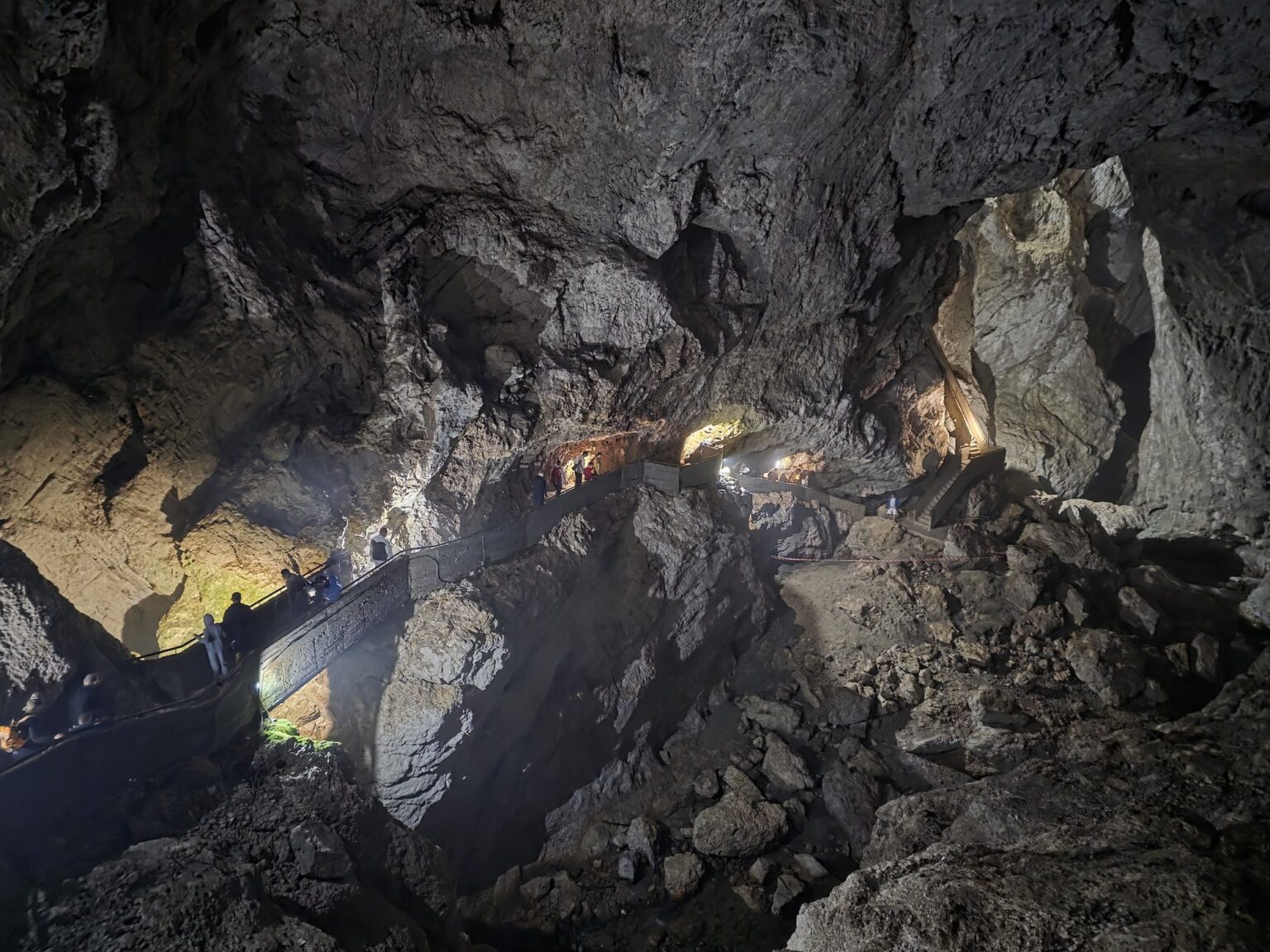
The tunnel ends and the Roaring Hall opens all at once. Over 35 metres high, more than 100 metres wide — numbers that only make sense once you find the walkway with people on it. This is where the Trigradska River lands after a 42-metre drop: the tallest underground waterfall in the Balkans. It is only the tallest of 18 waterfalls the river makes inside the cave; you simply cannot see the rest from the walkway.
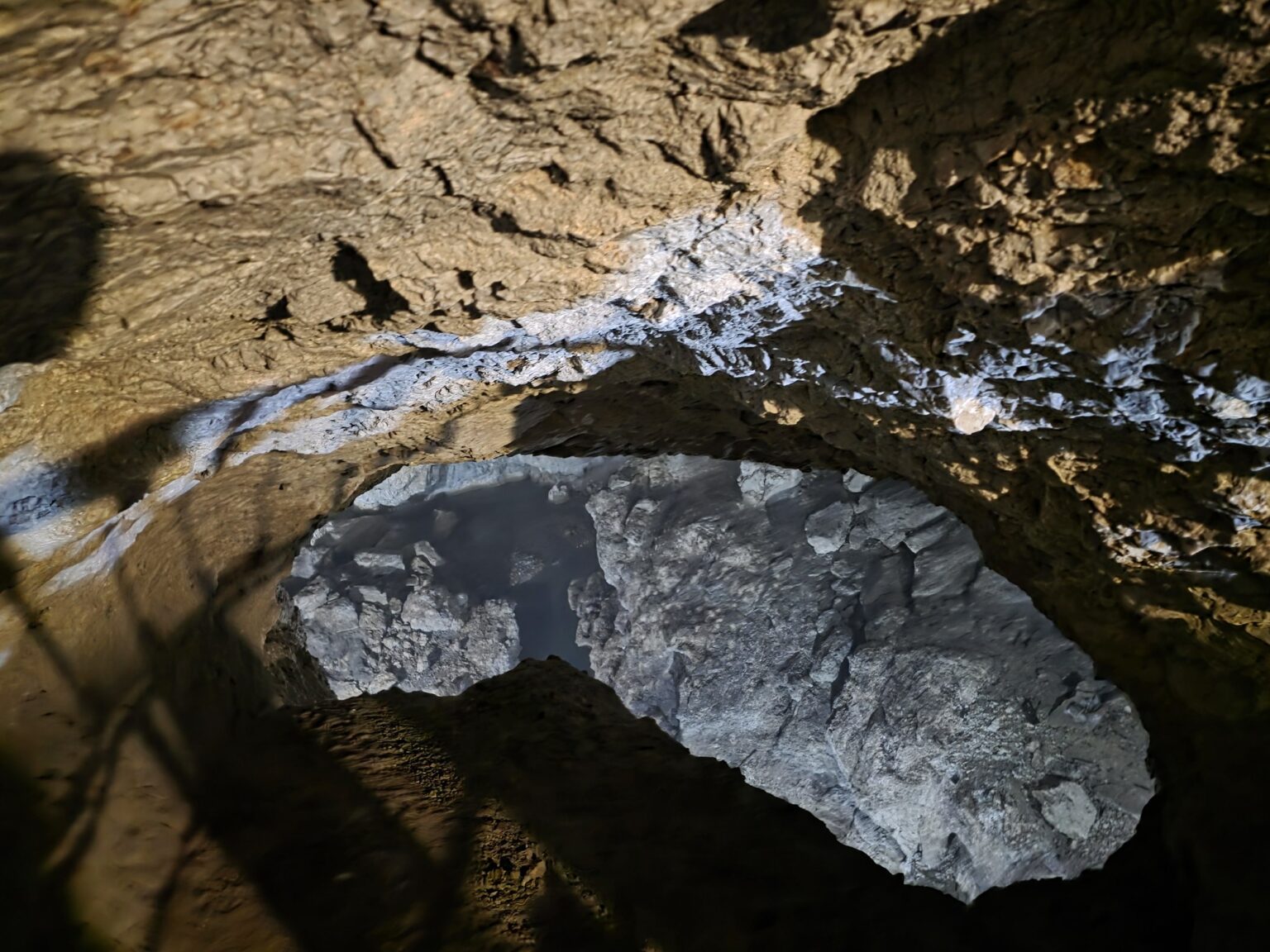
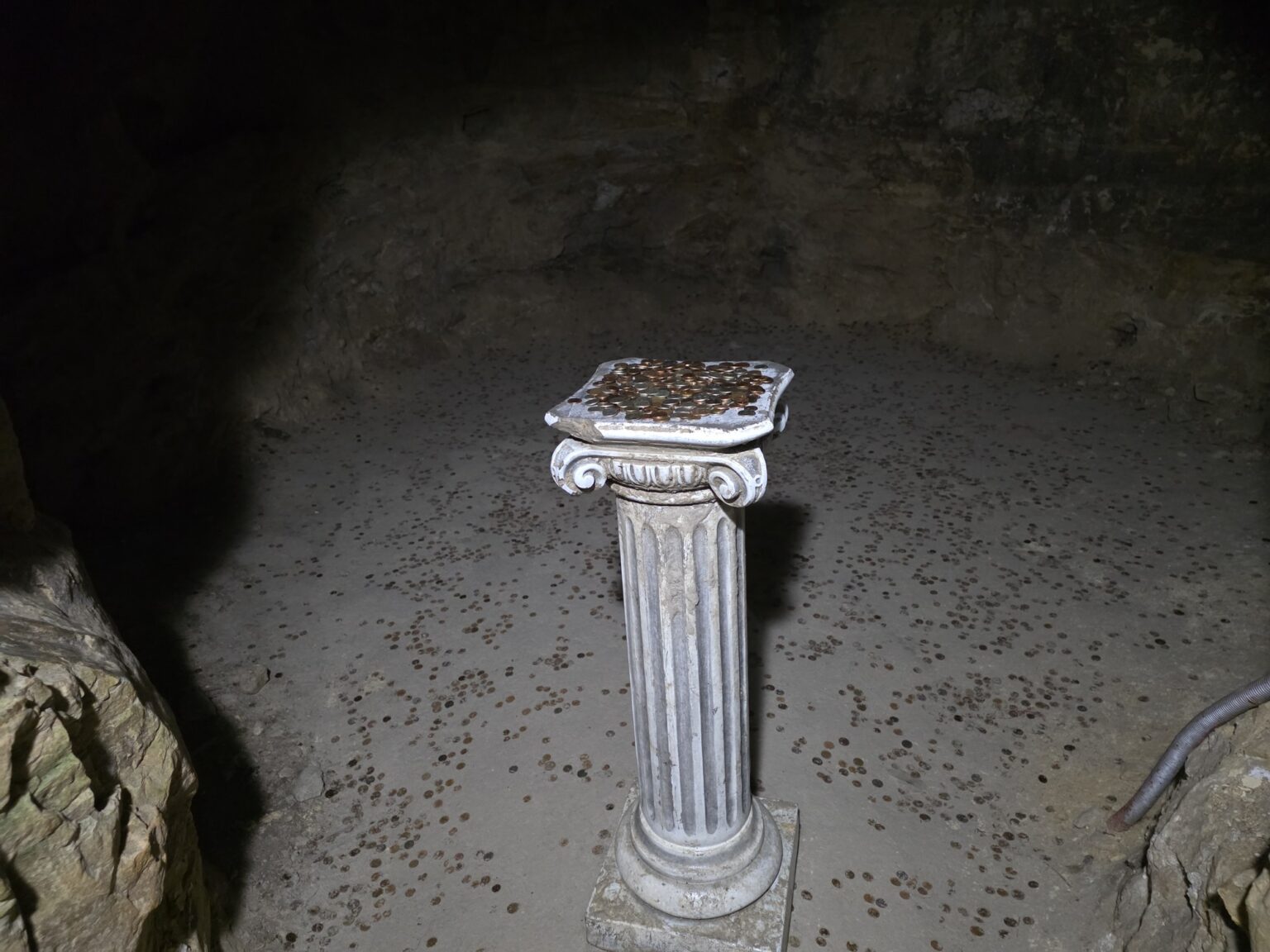
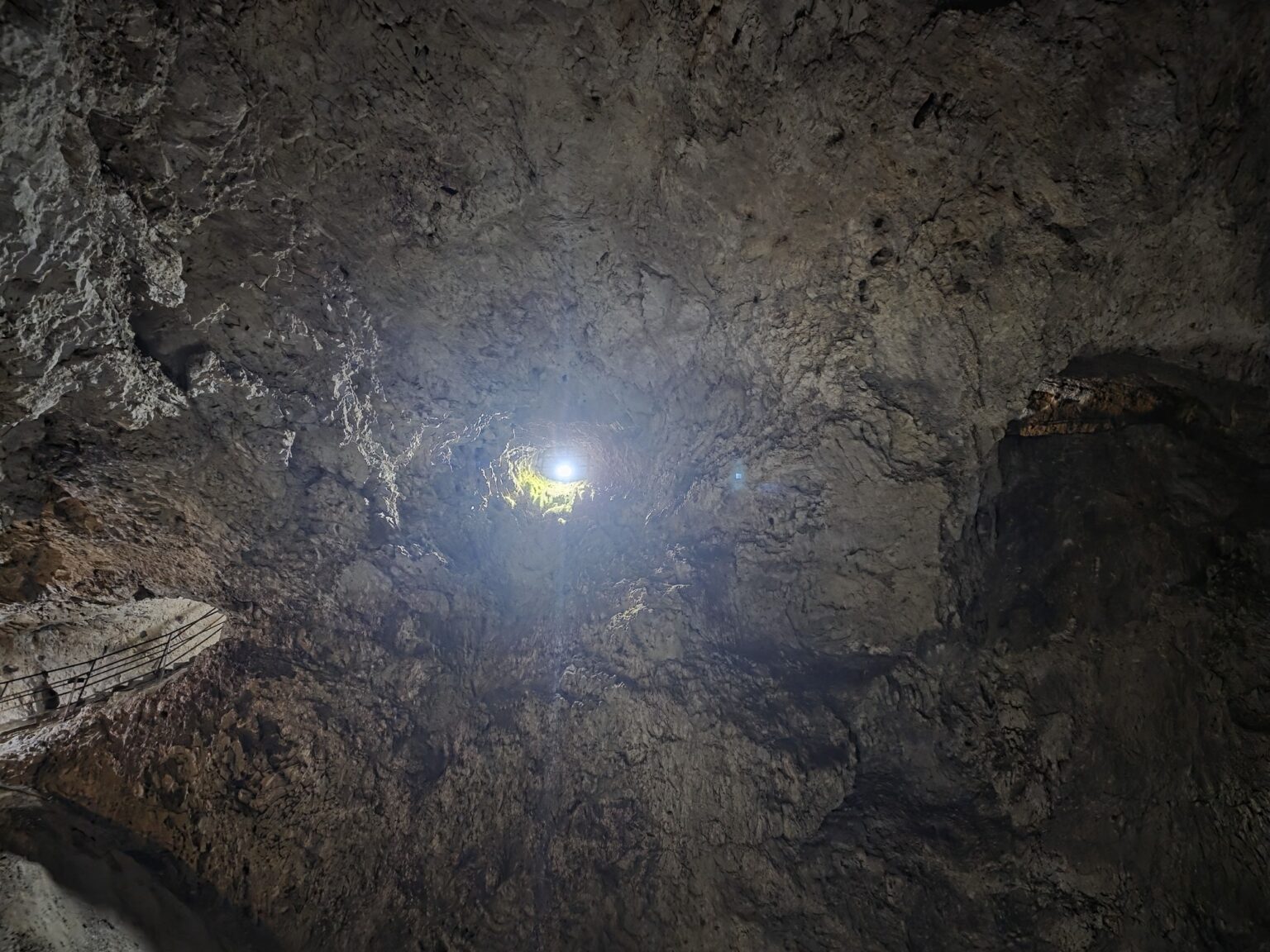
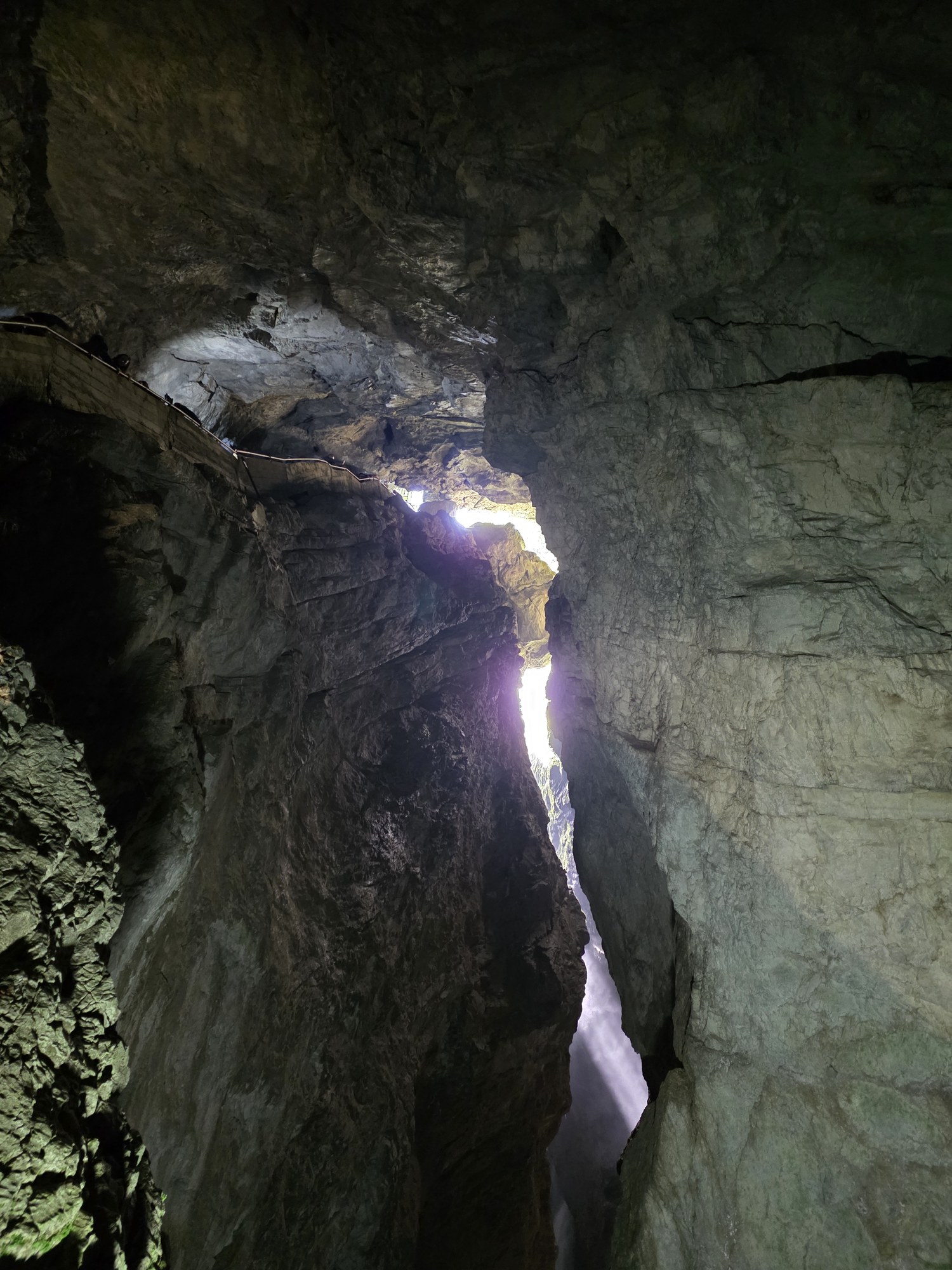
One pillar by the railing is silver from top to bottom with coins pushed into every crack. Of course it is. High above, the ceiling splits open and lets in the only daylight in the hall — that gap is the throat itself, seen from the inside.
Orpheus, Eurydice and 301 steps
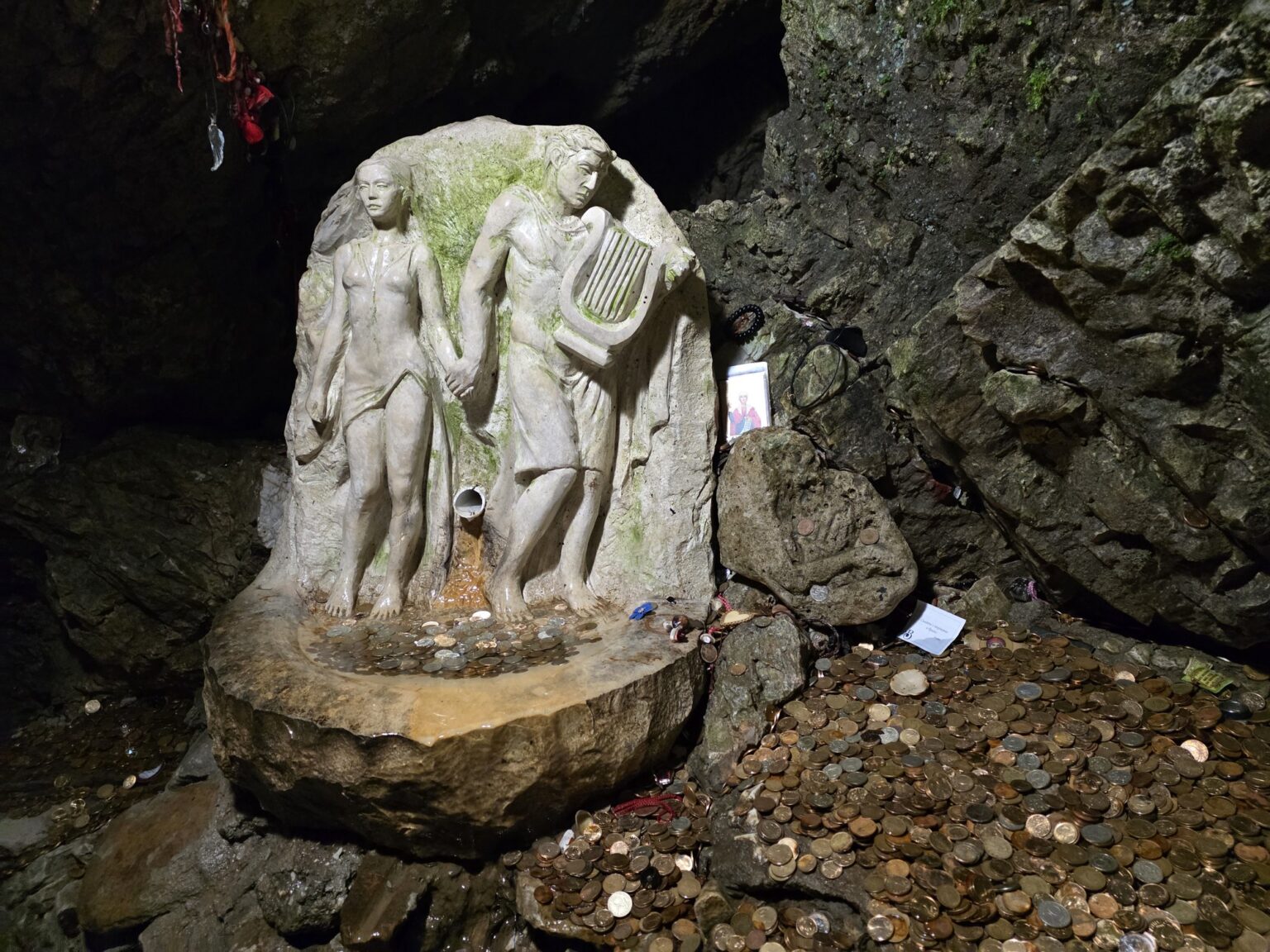
Halfway along, on a ledge beside the walkway, there is a white stone figure of a man and a woman around a small spring — Orpheus and Eurydice. People throw coins in and make a wish. The guides will tell you the wishes come true, while accepting no responsibility for them 🙂
After that it is all uphill. The visitor route is 350 metres out of a kilometre of cave and ends with 301 almost vertical steps running up beside the waterfall. The tightest section is a crack about as wide as one person with a rucksack, with water running down both walls and down you. I counted the steps. I regretted it somewhere around two hundred.
Whatever goes in does not come out
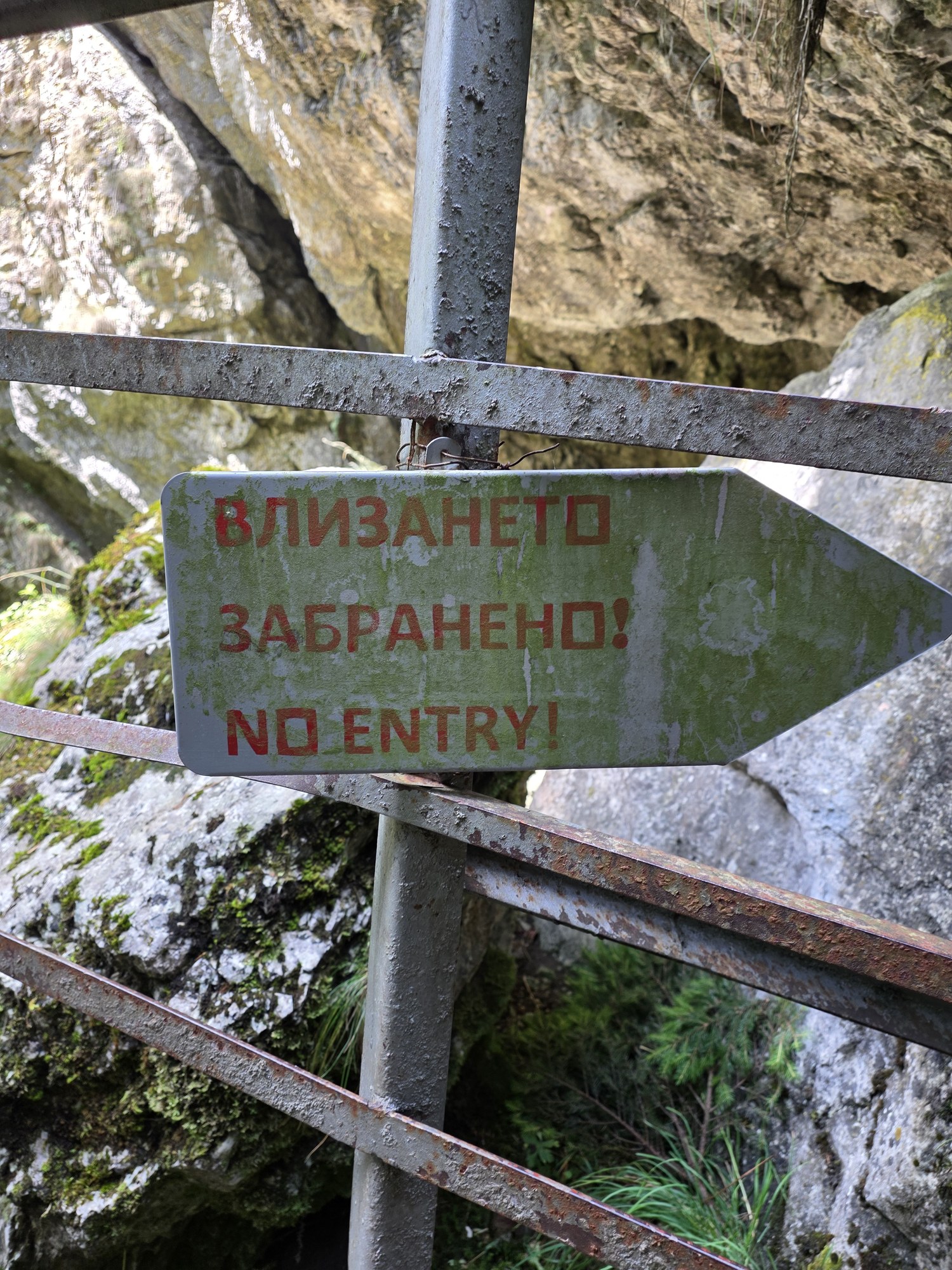
You come out into daylight up in the gorge, and right above the point where the river throws itself into the rock there is a green sign with two words on it: NO ENTRY. It is not a formality.
In 1968 the flooded Trigradska River swept trees, stones and everything else in its path into the throat. The river’s exit is 250 metres from where it goes in. Nothing came out. Two years later two young divers from Varna — Siana, 21, and Evstati, 29 — went into the siphon roped together to find out where it all goes. They did not come back. Their bodies were recovered, and a memorial plaque to them stands by the asphalt road just below the cave. It is the one spot on the route with no queue for photographs.
Bulgarian speleologists then released dye into the water. Over 250 metres, at that flow rate, the coloured water should have appeared in five to eight minutes. It appeared after two hours. Recalculated, that means the water covers roughly 25 kilometres somewhere along the way — and nobody knows where, to this day. Greek speleologists claim the 1968 timber surfaced in a cave on their side of the border; the Bulgarian theory is a second hall beneath the main one that recirculates the water like a trap in a drain. Both remain guesses. National Geographic put Devil’s Throat at number 42 on its list of the 100 most mysterious places in the world, and this is one of the rare cases where that kind of list does not feel inflated.
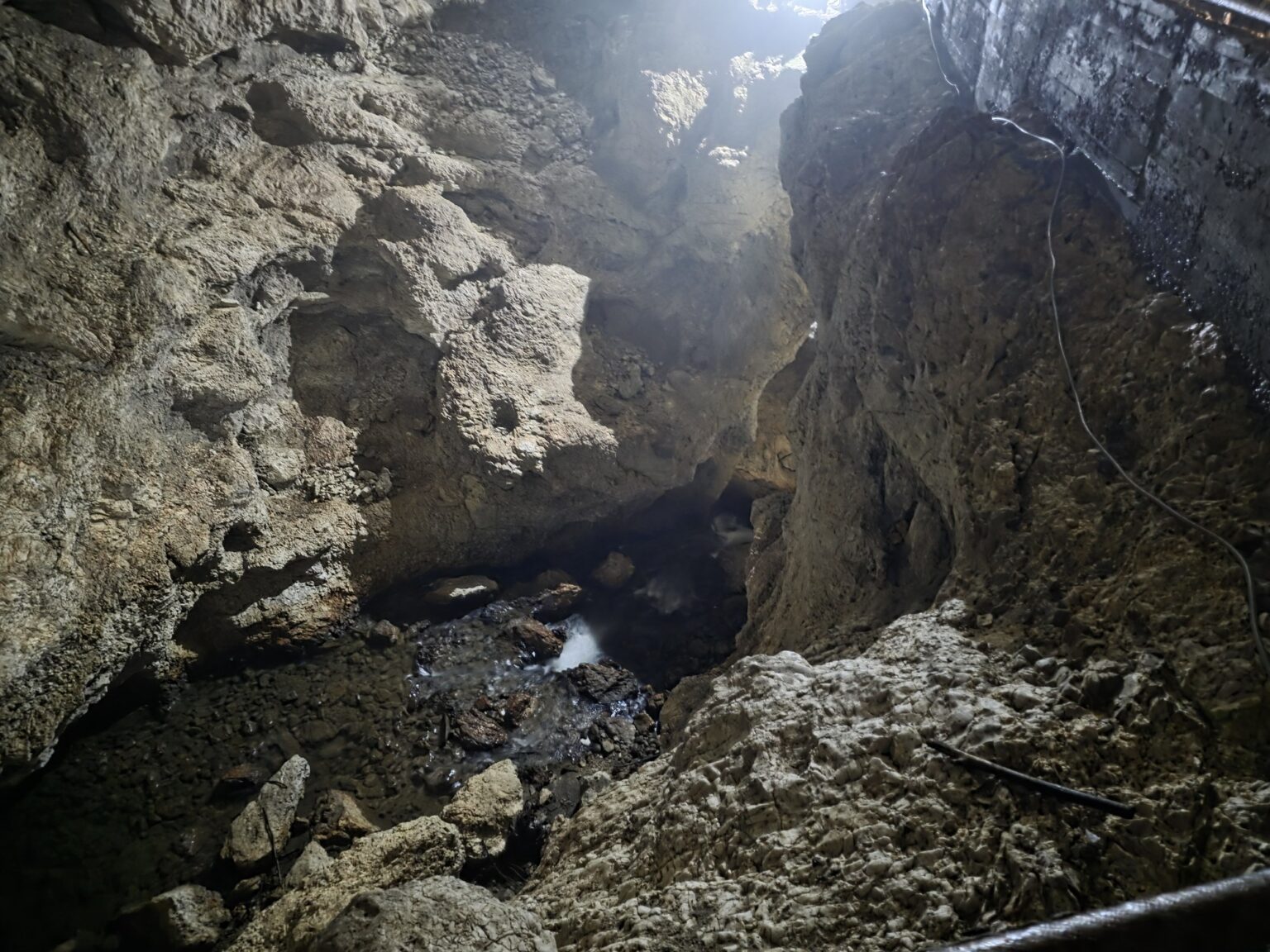
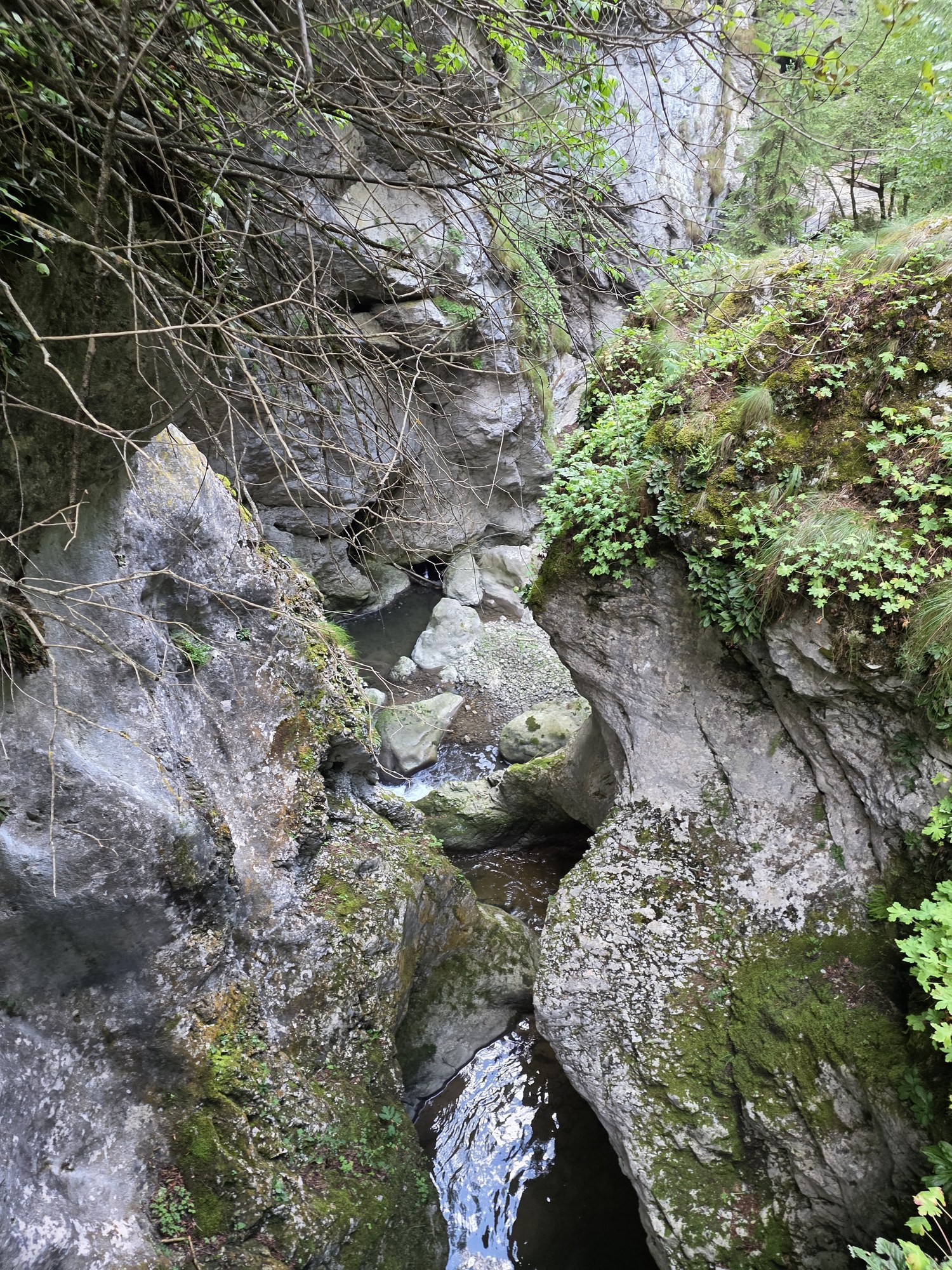
Just before we leave, the sun lines up with the slot between the walls and drops a single band of light onto the floor of the chasm. Below it: water, stone scoured white, and a bend that disappears into the cliff. Worth it, and for half an hour of your day. If you have more time in the area, Devin is the town most people base themselves in, and Dospat sits at the other end of the same Western Rhodopes.
Related video: there is no episode on Devil’s Throat alone yet, but the cave features in Top 10 Caves in Bulgaria — on video, alongside nine others worth the detour. And the drive in — Devin, the Vacha river and the Rhodope slopes around them — is filmed from the air in “Bulgaria From Above: Devin, Vacha & Krichim” and the rest of the Bulgaria From Above series.