Bulgarian food is generous, comforting and rarely in a hurry. A table can fill with roasted vegetables, yoghurt, pastry, slow-cooked meat and a small glass raised for good health. This list brings together ten traditional Bulgarian foods and drinks, each with its own taste and story. If you want to place the cuisine in a wider cultural context, our guide to fascinating facts about Bulgaria is a good next read.
Recipes vary from home to home, which is part of the pleasure. Do not worry if the same dish appears slightly different on another table; that is often how tradition stays alive. Several of these are seasonal by nature — made in autumn, eaten in winter — so what you find in a restaurant in July is not always the full picture.
Before the list, enjoy the video:
#10 — Lyutenitsa ▶ 0:34
📍 nationwide, made in autumn · 🍽 spread or side, eaten all year · 🥘 roasted red peppers, tomatoes, often aubergine
Lyutenitsa is less a recipe than an annual event. In September, when the peppers come in cheap and by the crate, the smell of roasting drifts through entire neighbourhoods, and families spend a weekend turning the harvest into jars that will last until spring. Recipes differ by household — more aubergine, more carrot, more chilli — and everyone insists their version is the correct one.
It is often confused with Serbian and Macedonian ajvar, but there is a clear difference: lyutenitsa contains tomato, ajvar does not. Eat it on bread with white cheese, alongside grilled meat, or straight from the jar with a spoon, which is what most Bulgarians actually do.
#9 — Shopska salad ▶ 0:56
📍 the Shopluk region around Sofia · 🍽 starter, at its best in summer · 🥘 tomatoes, cucumbers, peppers, white cheese
The most famous Bulgarian dish abroad is also one of the youngest on this list. The salad takes its name from the Shopi of the Sofia region, but in its present form it was popularised during the socialist era by the state tourism organisation as a dish to serve to foreign visitors — white cheese, red tomato and green pepper matching the colours of the national flag.
Everything rests on the ingredients, since there is nowhere to hide: ripe summer tomatoes, real brined white cheese grated over the top, salt, vinegar and sunflower oil. It is the standard companion to a first glass of rakia, and ordering one is the safest thing you can do in any Bulgarian restaurant.
#8 — Mekitsi ▶ 1:18
📍 nationwide · 🍽 breakfast · 🥘 yoghurt dough, deep-fried
Mekitsi are pieces of soft yoghurt dough stretched by hand and fried until they puff up and turn gold. They belong to the morning: made fresh, eaten immediately, and never quite as good once they have cooled.
The toppings split the country. Some households insist on powdered sugar or jam, others on honey, and a large camp eats them with crumbled white cheese instead — the savoury version deserves a try even if the sweet one sounds more obvious. Related fried doughs exist across the Balkans, but the yoghurt in the dough is what makes these particularly light.
#7 — Boza ▶ 1:39
📍 a Balkan tradition, widespread in Bulgaria · 🍽 breakfast, classically with banitsa · 🥘 lightly fermented wheat or millet
Boza is thick, beige, faintly sour and completely unlike anything in a Western breakfast. It is made by fermenting cereal flour, which leaves only a trace of alcohol — small enough that it has always been sold to children as a normal morning drink.
The pairing that matters is boza and banitsa: cheese pastry and a cold glass of boza is the standard Bulgarian breakfast, sold together at bakeries in every town. Visitors either take to it on the first sip or never again, and both reactions are entirely normal.
#6 — Tikvenik ▶ 2:07
📍 nationwide · 🍽 dessert, a fixture of Christmas Eve · 🥘 pumpkin, walnuts, cinnamon, filo pastry
Tikvenik is a rolled pastry filled with grated pumpkin, crushed walnuts, sugar and cinnamon, baked until the filo is crisp and dusted with icing sugar before serving. It is autumn food in the most literal sense — pumpkins are harvested in October and used through the winter.
Its fixed place is the Christmas Eve table, which in Bulgarian tradition is meatless and contains an odd number of dishes. Tikvenik satisfies both conditions, which is why it appears in essentially every household on 24 December, often with a coin hidden in one slice for luck.
#5 — Patatnik ▶ 2:28
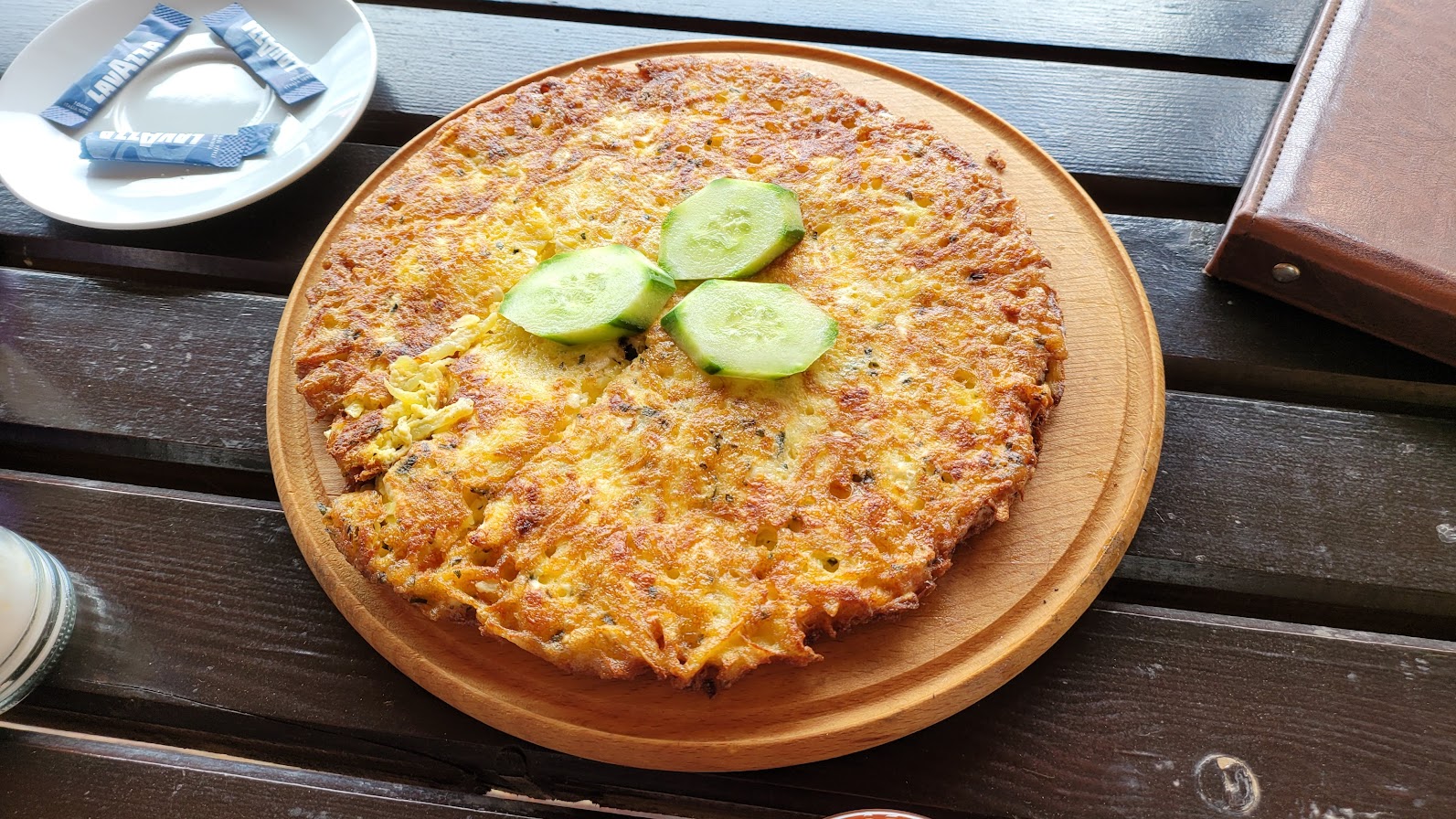
📍 the Rhodopes, around Smolyan · 🍽 main dish, mountain food · 🥘 grated potatoes, onion, savory
Unlike most dishes here, patatnik has a precise home: the Rhodope mountains. Grated potatoes and onion are seasoned heavily with Rhodope savory — the herb locals call merudiya — and baked into a flat cake, traditionally in a covered pan set among the embers.
The result is crisp outside and soft inside, and it is served with yoghurt, white cheese or nothing at all. If you are travelling through Smolyan, Chepelare or the villages around them, this is the dish to order rather than anything from the standard national menu.
#4 — Kapama ▶ 2:49
📍 most strongly associated with Bansko · 🍽 festive, winter · 🥘 several meats, sauerkraut, rice
Kapama is the opposite of everyday cooking. Several kinds of meat — pork, chicken, sometimes sausage and game — are layered with rice and sauerkraut leaves in a clay pot, which is then sealed and left in a low oven for hours. The name comes from the covering, and the sealing is the point: nothing escapes.
Bansko treats it as a local emblem and gives it its own celebration in winter, which is when the dish makes most sense anyway. It is prepared for Christmas and New Year in the Pirin region and takes long enough that nobody makes it for a weekday dinner.
#3 — Sarmi ▶ 3:10
📍 nationwide, shared across the Balkans · 🍽 festive and everyday · 🥘 vine or cabbage leaves, rice, minced meat
There are two sarmi, and knowing the difference helps. In summer, fresh vine leaves are used, with a lighter filling of rice, herbs and sometimes meat. In winter the wrapping is sauerkraut leaf, which is sharper and much more robust — these are the ones that appear at Christmas and New Year.
The Christmas Eve version is meatless, filled with rice, onion and dried herbs, and served without yoghurt on the fasting table. Rolling them takes real patience, which is why they are usually made in large batches by more than one pair of hands.
#2 — Kavarma ▶ 3:32
📍 nationwide · 🍽 main dish, autumn and winter · 🥘 meat, onions, peppers, baked in a clay pot
Kavarma is meat, onion and pepper cooked down slowly in its own juices, usually finished in individual earthenware pots and brought to the table still bubbling. The clay is not decoration — it holds heat and lets the dish keep cooking after it leaves the oven.
The name comes from the Turkish kavurma, a reminder of how much of the Balkan kitchen is shared. Versions vary with the region and the season: pork is the default, mushrooms and tomato are common, and an egg cracked on top before the last minutes in the oven is a frequent addition.
#1 — Rakia ▶ 3:53
📍 nationwide, home-distilled in autumn · 🍽 at the start of the meal, with salad · 🥘 distilled grapes or plums
The one thing foreign visitors most often get wrong: rakia is not a digestif. It is drunk at the beginning of the meal, slowly, alongside a shopska salad and conversation — never knocked back after dessert. Grape is the most common base, plum the other classic, and apricot, pear and quince all have their followers.
Home distilling remains a genuine tradition rather than folklore. Every autumn, licensed village stills work through the fruit that families bring in, and the results are compared with complete seriousness for the rest of the year. Homemade rakia is generally stronger than the bottled kind, so treat an unlabelled bottle with respect.
For more Bulgarian culture after the meal, our historical sites guide is a satisfying next stop.